
As organizations dive into AI adoption, many realize the first real bottleneck is not the model but how to prepare their information so it can be used effectively in AI workflows.
Quelle: AI data governance guidance that gets you to the finish line
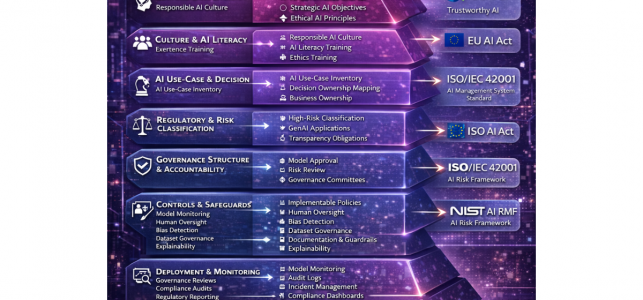
From Principles to Systemic AI Governance Architecture Artificial Intelligence is rapidly transforming how organizations make decisions, automate processes, and design digital services. From generative AI assistants to autonomous decision systems, AI is becoming a core infrastructure of the modern economy. At the same time, governments and regulators around the world …
EU AI Act Omnibus discussions & Documents Over the weekend I noticed something interesting on LinkedIn.Several posts about the EU AI Act Omnibus discussions started circulating — many sounding rather alarmist.Some suggested organisations should expect major regulatory uncertainty or even delay AI governance efforts. My take: This creates more confusion than clarity. Here’s why …
As organizations dive into AI adoption, many realize the first real bottleneck is not the model but how to prepare their information so it can be used effectively in AI workflows.
Quelle: AI data governance guidance that gets you to the finish line
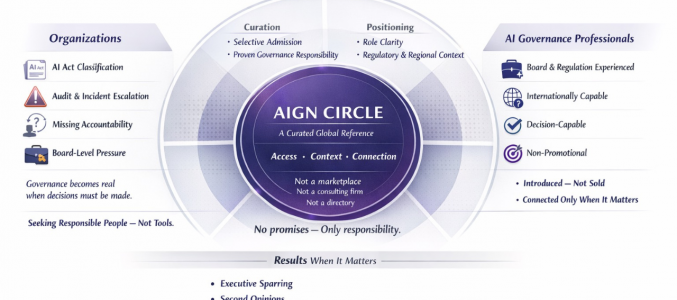
AI governance is discussed everywhere. But very rarely is one question answered clearly: When does it actually exist? Across frameworks, principles, maturity models, and toolkits, one pattern keeps repeating:AI governance is described extensively — but it is not activated when it matters most. Through extensive analysis of regulatory practice, board-level escalation cases, and …
Why the WEF Global Risks Report 2026 requires an AI Governance Operating System 1. What the WEF Report Diagnoses The WEF Global Risks Report 2026 makes one structural shift unmistakably clear: AI is no longer a sectoral or technological risk.It has become a systemic force shaping economies, societies, and decision-making itself. The report …
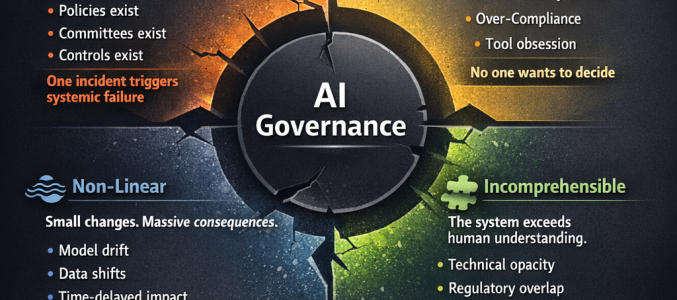
With board members. Legal leaders. Technology team A personal observation from real conversations. BANI describes a world that is brittle, anxious, non-linear, and increasingly incomprehensible — where systems fail suddenly and responsibility becomes harder to assign. AI governance doesn’t fail because frameworks are missing.It fails when responsibility disappears. Over the …
AI governance has crossed a structural threshold. What was once an ethics discussion has become an operational, legal, and board-level responsibility. Global data shows a consistent pattern: regulation is accelerating, liability is personalizing, costs are rising, and governance increasingly fails not because of missing frameworks—but because no one can credibly carry responsibility …
Was Unternehmen jetzt tun müssen – und warum Beratung & Governance entscheidend werden Die NIS2-Richtlinie ist in nationales Recht übertragen und entfaltet spätestens 2026 ihre volle Wirkung. Sie betrifft nicht nur klassische KRITIS-Unternehmen, sondern über 30 neue Branchen, darunter Fertigung, Abfallwirtschaft, Postdienste, Lebensmittel, Energie, Transport, Verwaltung, Finanzwesen und Digitaldienstleister. Damit wird NIS2 zur breitesten …
Why Autonomous AI Systems Are Outrunning Global Oversight — And What Leaders Must Build Now Autonomous AI agents are no longer prototypes or research experiments. Over the past twelve months, they have quietly moved into mission-critical workflows across finance, healthcare, public services, logistics, manufacturing, and energy infrastructure. These agents now …
Why AI Fails in Modern Enterprises — and the New Governance Function Every CEO Will Need in 2026 By Patrick Upmann — Architect of Systemic AI Governance. Something strange is happening inside modern enterprises. Despite record investments in AI, cloud, cybersecurity and digital transformation, organizations are becoming less able to make decisions, …
NIS2: Deutschland unterschätzt den Governance-Schock – und warum jetzt Struktur statt Tools zählt Deutschland ist spät dran.Deutschland ist spät dran.Mit dem NIS2-Umsetzungsgesetz tritt die europaweit schärfste Cyberregulierung nahezu ohne Übergangsfrist in Kraft. Unternehmen müssen ihre Sicherheits- und Governance-Strukturen sofort neu ausrichten. Aus Sicht von Patrick Upmann, Berater und Entwickler systemischer Governance-Architekturen, …
Mark a Global Turning Point — Now Comes the Architecture From Safe and Trusted AI to systemic architecture. India’s Governance Guidelines set the vision. AIGN OS could serve as the operational layer — the architecture that turns policy into practice. Patrick Upmann is the architect of AIGN OS – The …
The Global Education Infrastructure for Responsible AI A New Kind of Academy for a New Kind of Intelligence. Artificial Intelligence is transforming the operating logic of our world — faster than regulation, education, or culture can adapt.It governs economies, public decisions, and digital life itself. Yet while algorithms evolve exponentially, …
How AIGN OS Operationalizes the World ECONOMIC FORUM Responsible AI Playbook 2025 The new World Economic Forum Responsible AI Innovation Playbook (2025) outlines what organizations must do – nine “Plays” across strategy, governance, and development. The bottleneck is how: less than 1% of organizations have fully operationalized Responsible AI. –> AI Innovation: A Playbook by World Economic …
Speaker at TRT World Forum 2025 · Architect of the world’s first AI Governance Operating System · Trusted voice for corporate leaders At the TRT World Forum 2025 in Istanbul, global leaders, policymakers, and innovators gather to shape the debates that define our future. Among them: Patrick Upmann, internationally recognized as the architect …
The First AI Education Trust Label in APAC In September 2025, history was written in Seoul, South Korea: Fayston Preparatory School became the first institution in Asia to receive the AIGN Education Trust Label. For me, as Founder of AIGN – Artificial Intelligence Governance Network and architect of the AIGN OS – The Operating System …
AI Governance is rising. But still not ready. But still not ready.The world is beginning to build governance structures for Artificial Intelligence – but the system is far from stable. The latest ASGR – AIGN Systemic Governance Readiness Index stands at 42.6 out of 100 in August 2025. This marks clear progress compared …
The Global Score for Responsible AI Governance Everyone’s talking about AI governance. But who’s actually building it? While regulations accelerate and risks proliferate, there’s still no global metric to assess how prepared the world truly is for the systemic governance of artificial intelligence. That’s why we built ASGR.The AIGN Systemic Governance …
Why the future of AI regulation depends on architecture — not awareness. This is not another overview. It’s a reality check. In 2025, AI governance has become an industry — but not a solution. Every new regulation triggers a surge of templates. Every conference has “AI Ethics & Governance” panels. …
How the AIGN Data Act AI Governance Framework Transforms Compliance into Competitive Advantage 2025 – A Defining Year for Data & AI Governance 2025 marks a historic turning point for Europe’s digital economy—one with global consequences. On September 12, the EU Data Act comes into force, accompanied by the Data Governance Act (DGA), …