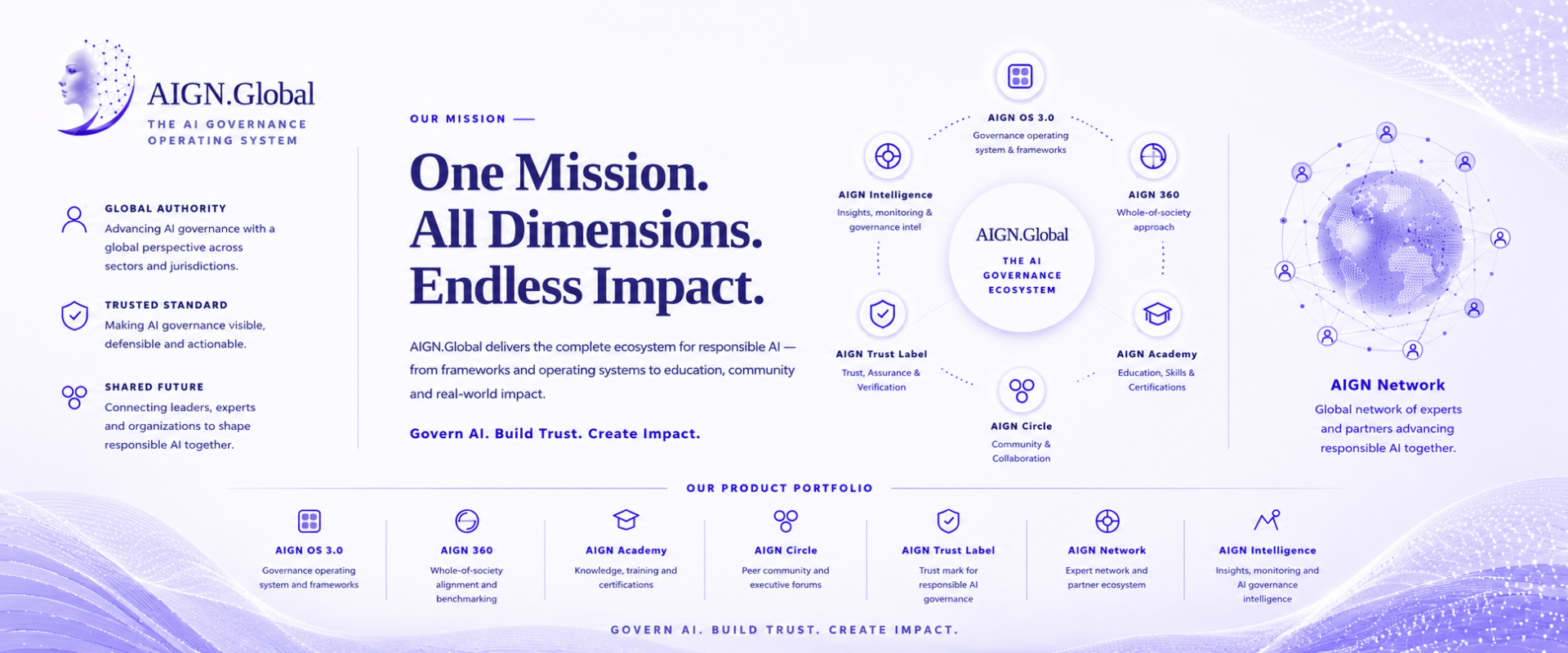
AIGN Research
Governing machine authority in high-consequence systems.
Applied research on machine authority, defensible autonomy and AI governance in critical infrastructure and other high-consequence environments.
From governance principles to operational models for AI-enabled systems that can inform, decide and act.
Research at the boundary between intelligence and authority
Artificial intelligence is moving beyond generating information. AI-enabled systems increasingly support operational decisions, interact with digital and physical infrastructure, and take actions with real-world consequences.
This raises a fundamental research question:
Under what conditions may an AI-enabled system act without real-time human confirmation, while human accountability remains clearly anchored?
AIGN Research studies the authority, accountability and evidence structures needed to govern such systems. The work connects AI governance, operational risk, technical control mechanisms and institutional oversight, with particular attention to environments where system behaviour may affect public safety, essential services or organisational continuity.
Research areas
Machine authority and defensible autonomy
How should the authority of an AI-enabled system be granted, bounded and controlled? Topics include operational mandates, delegated authority, authority boundaries, human accountability anchors and evidence of authorised behaviour.
AI governance in critical infrastructure
How can governance operate where AI-supported decisions may have physical, societal or systemic consequences? Topics include monitoring, early warning, escalation, human intervention and accountability for consequential actions.
Runtime governance and evidence
How can governance requirements stay effective while systems operate? Topics include policy enforcement, monitoring, intervention mechanisms, logging, auditability and the reconstruction of consequential system actions.
Cross-border and cross-sector governance
How should AI-enabled systems be governed when data, decisions and consequences cross organisational, sectoral or national boundaries? Topics include distributed accountability, institutional coordination and shared operational authority.
Projects and collaborations
AIGN Research develops applied research projects together with academic and practice partners. Project descriptions, partners and results are published once they have been agreed with the participants.
Publications and prior work
AIGN Research builds on Patrick Upmann’s published work. Outputs are labelled by type. Peer review is stated only where it has taken place.
Working papers
- Upmann, P. (2025). AIGN OS – The Operating System for Responsible AI Governance. SSRN working paper. doi.org/10.2139/ssrn.5382603
- Upmann, P. (2025). AIGN Systemic AI Governance Stress Test. SSRN working paper. doi.org/10.2139/ssrn.5489746
- Upmann, P. (2025). AIGN OS – AI Agents: The AI Governance Stack as a New Regulatory Infrastructure. SSRN working paper. doi.org/10.2139/ssrn.5543162
Books and concepts
- Defensible autonomy. Book: Defensible Autonomy: From AI Agent Capability to Accountable Enterprise Action (Amazon KDP). It examines the conditions under which AI-enabled systems may exercise delegated authority within defined boundaries, runtime controls and human accountability structures. [TO CONFIRM: publication year]
- The authority supply chain. Concept introduced in The AI Governance Gap Brief (issue 32, August 2026). It asks how authority is granted, transferred, constrained and evidenced across interconnected systems, organisations and jurisdictions.
Research lead
Patrick Upmann · Founder, AIGN · Independent AI Governance Advisor
Patrick Upmann has more than 25 years of experience in IT governance, risk and compliance across finance, energy, automotive and retail. His research addresses machine authority, defensible autonomy and governance in high-consequence systems.
Recent engagement: Advanced Research Workshop, Yerevan
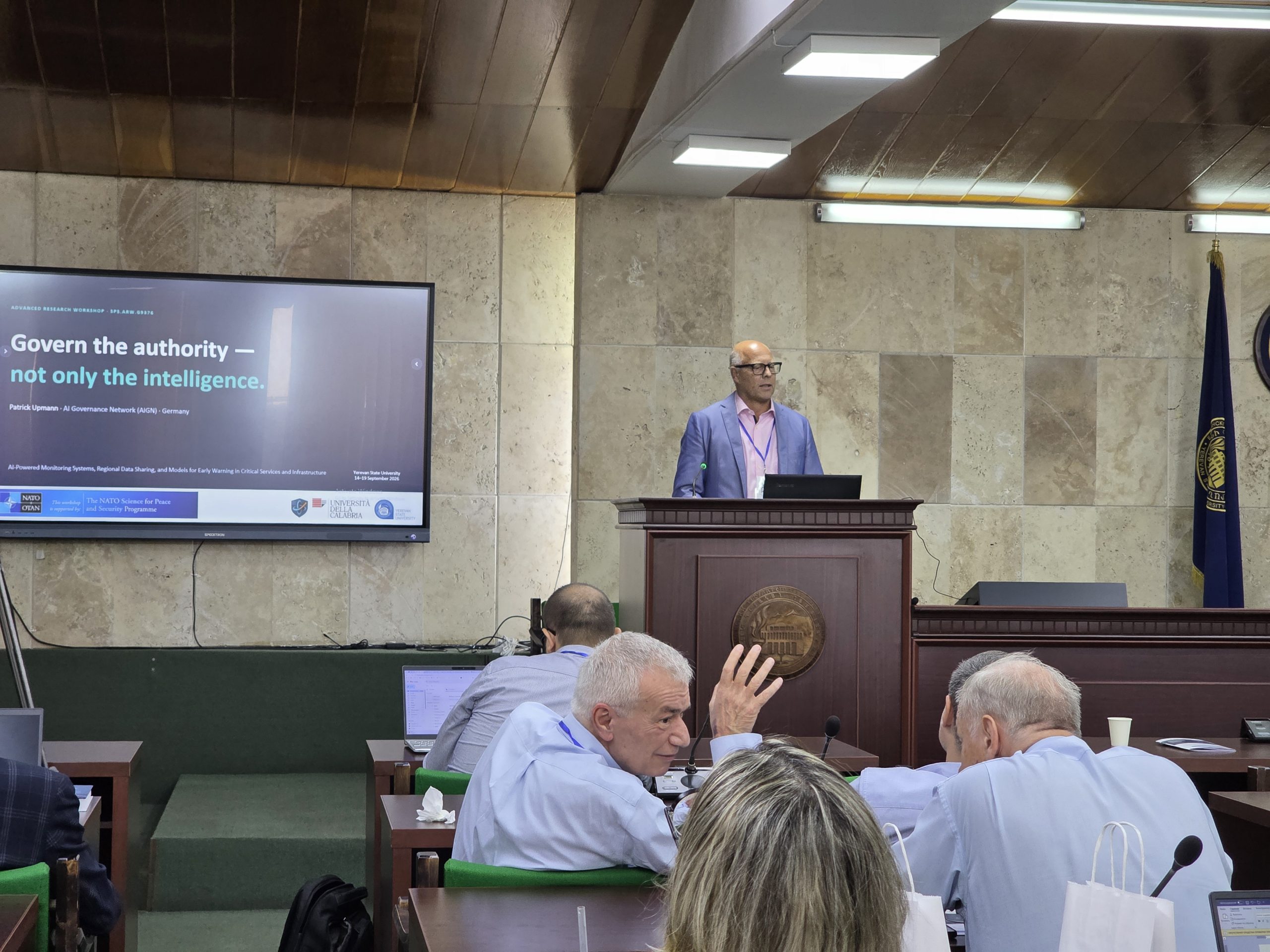
- Workshop: AI-Powered Monitoring Systems, Regional Data Sharing, and Models for Early Warning in Critical Services and Infrastructure, 14–19 September 2026, Yerevan State University, Armenia
- Organisers: CenTRiS Foundation (Armenia) and University of Calabria (Italy), with NATO SPS support under grant ARW.G9376
- Keynote, 16 September (Session 2.2, Governance and trust frameworks): “From innovation to implementation — building governance frameworks for AI in critical sectors”
- Round table co-chair, 17 September: “Toward a regional data-sharing framework for critical infrastructure”, with Prof. Ramaz Kvatadze (GRENA, Georgia)
[TO CONFIRM] Travel and accommodation for invited speakers were covered by the workshop’s NATO SPS project budget. This is a documented speaking engagement. It does not constitute NATO endorsement of, or funding for, AIGN Research.
Research cooperation
AIGN Research welcomes discussions with universities, research centres, critical infrastructure operators and other organisations investigating the governance of AI-enabled systems. Cooperation is developed with explicit agreement on scope, responsibilities, funding, intellectual property and publication rights.
Patrick Upmann · AIGN Research
Munich and Thuringia, Germany · International research cooperation
AIGN Research is an applied research initiative of AIGN.Global. The legal entity responsible for this website is named in the legal notice.