

Serious AI
Governance needs
serious challenge.
AI Governance professionals — interim managers, consultants, internal leads and executive owners — operate in a field where few people can genuinely challenge their reasoning. AIGN Sparring is the curated peer circle that tests your assumptions before regulators, boards, clients or auditors do.
Less than one advisory hour per month. More practical than another stack of governance reports.
Peer-led. AIGN-structured. No lectures. No webinars. No passive listening. Serious AI Governance professionals testing each other’s judgment.
Core EU AI Act high-risk obligations: from 2 August 2026
DORA: applicable since 17 January 2025
EU AI Act penalties: up to €35m or 7% of worldwide annual turnover for the most serious infringements
Founding Cohort: 10 seats · Financial Services
Who challenges
your thinking
right now?
The people who do this work — the interim manager between mandates, the consultant navigating client politics, the internal AI governance lead surrounded by colleagues who do not speak the language — often have no genuine peer to test their reasoning against. Nobody above them understands the operational reality. Nobody below them has the authority to push back.
“Am I classifying this AI use case correctly under the EU AI Act — or will an auditor find something I missed?”
“My board wants a governance framework by next quarter. Is my approach actually defensible — or just good-looking?”
“Everyone in my organisation nods along. Who is in a position to tell me when my reasoning is wrong?”
“DORA, ISO 42001, the Digital Omnibus. The regulatory landscape is reshaping itself every quarter. How do I keep up — alone?”
The gap between
frameworks and
defensible judgment
is where accountability
becomes personal.
AI governance is no longer a documentation exercise. It is becoming an accountability function — with real consequences for the professionals who design, approve or defend it. Regulatory frameworks tell you what to do. They do not test whether your reasoning holds under pressure. That is what serious peers are for.
Maximum EU AI Act penalty for the most serious infringements — up to €35m or 7% of worldwide annual turnover
of senior leaders say their organisations are incorporating AI governance (EY Pulse Survey)
Core high-risk AI obligations become applicable — the preparation window is now
Not a course. Not a webinar.
A peer circle with teeth.
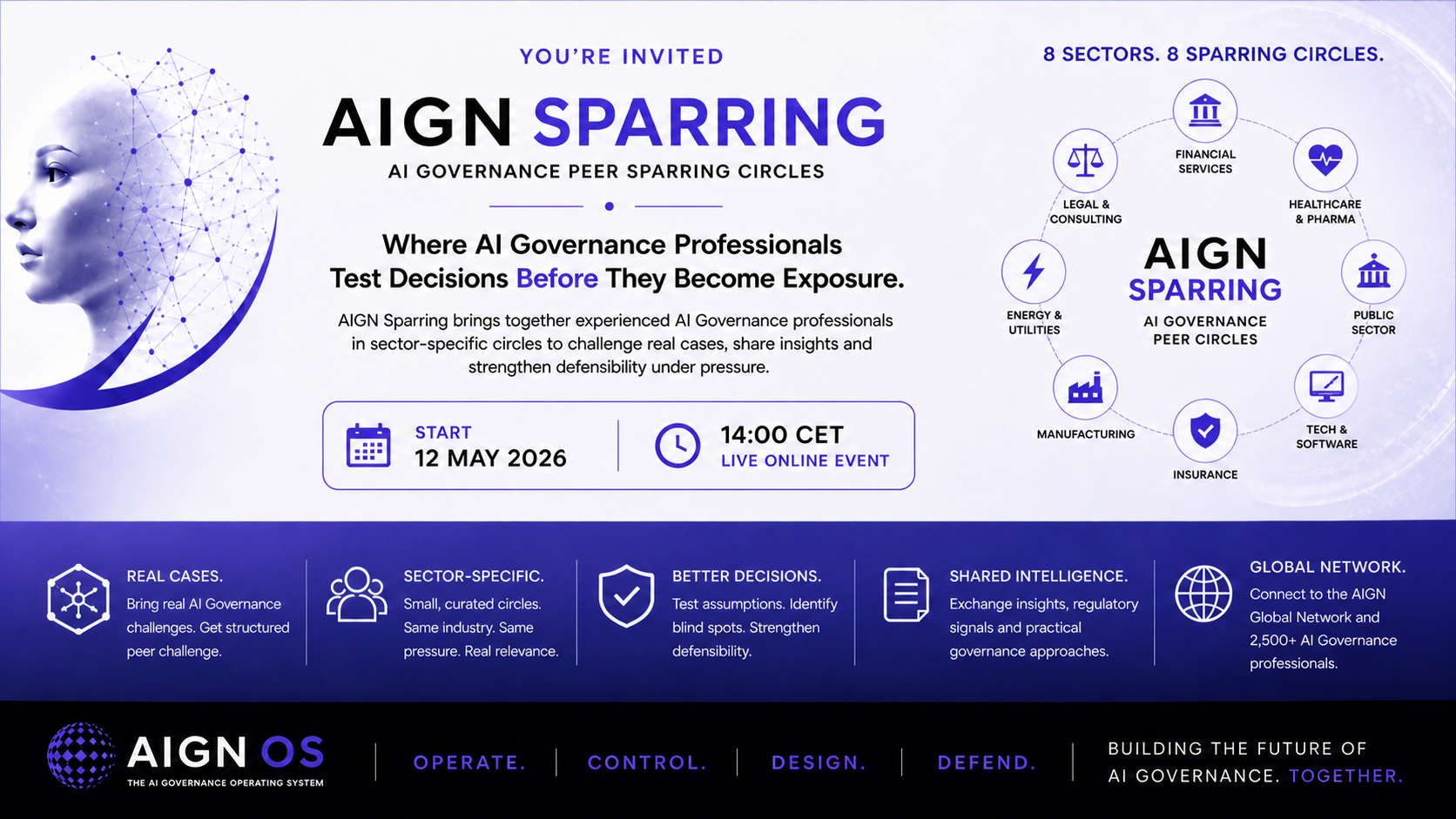
AIGN Sparring is a curated, sector-specific peer circle for AI Governance professionals who need structured challenge, defensible judgment and operational clarity — without another course, webinar or generic community.
Your group is peer-led, but not unstructured. AIGN provides the sparring formats, rules of engagement and the shared governance language. The value is not facilitation — it is the quality of the room.
Ratings tell you where you stand. Sparring tests whether your reasoning holds.
Built for the practitioner.
Not the boardroom.
The Interim Manager
Between mandates or deep inside one — without institutional backing, without a peer network, and without the luxury of getting the judgment call wrong.
“I need someone who understands what it actually means to own AI governance in a regulated institution — not someone who will sell me a certification.”
The Internal Lead
The AI Governance Officer, the Head of Responsible AI, the AI Risk Lead — surrounded by colleagues who don’t speak the language and a board that wants answers yesterday.
“Everyone nods. Nobody pushes back. I need a room where someone tells me when my reasoning is wrong before an auditor does.”
The Consultant & Advisor
Advising clients on AI Act compliance, governance frameworks, board readiness — while navigating the professional liability that comes with it.
“My clients expect authoritative answers. I need a peer group that stress-tests my thinking before I walk into the room.”
Find your industry.
Find your sparring partner.
AI Governance in a bank is not the same as in a hospital. Each group is built around one industry — same regulatory pressure, same operational reality, no cross-sector small talk. Select your sector to see the current sparring topics.
“DORA has applied since 17 January 2025. Where exactly does AI governance end and ICT risk management begin — and who owns the overlap in practice?”
BaFin’s latest guidance treats AI use as a material ICT risk topic under DORA-related risk management. The question is no longer whether digital operational resilience matters — but how AI-related ICT risks are governed in practice.
“Our credit scoring model is likely high-risk under the AI Act. High-risk obligations apply from 2 August 2026 — are we building the right foundations now?”
Even if political simplification discussions continue, organisations cannot wait to build documentation, oversight and auditability. The preparation window is now.
“How do I govern an AI vendor whose subcontractors I have never seen — and still satisfy DORA’s third-party requirements?”
Third-party risk chains in AI procurement are opaque. DORA requires full oversight down the chain — a challenge most governance teams have not yet structurally resolved.
“Our diagnostic AI tool sits between MDR and the EU AI Act. Which framework governs — and what if the requirements conflict?”
Medical device regulation and the AI Act overlap for clinical AI tools. The interplay between CE marking and AI Act Article 6 obligations remains genuinely unresolved for many organisations.
“Who holds clinical accountability when an AI recommendation contributes to a wrong treatment decision?”
Human oversight requirements under the AI Act meet medical liability law. The accountability gap between clinician, developer and deployer is widening as AI moves deeper into clinical workflows.
“How do we govern AI in clinical trials without slowing down timelines that cost months and millions?”
AI in drug development is under increasing regulatory scrutiny. EMA guidance is evolving and most governance frameworks have not yet caught up with the pace of adoption in research environments.
“We use AI in benefit eligibility decisions. The AI Act classifies this as high-risk. How do we govern something this politically sensitive?”
Annex III of the AI Act explicitly covers AI in public services affecting citizens. Democratic accountability requirements go significantly beyond technical compliance.
“We procured an AI system from a vendor who claims compliance. How do we verify it — without internal technical capacity?”
Most public sector bodies currently rely on vendor self-declarations. Third-party audit requirements under the AI Act are still being operationalised across member states.
“A journalist asks us to explain an AI decision that affected thousands of citizens. What does meaningful transparency look like in practice?”
Transparency obligations in government AI are both a legal and democratic challenge. The explainability tools available rarely match the political and public accountability reality.
“We build on top of a foundation model. Does that make us a provider, a deployer — or both? Getting the role allocation wrong creates serious compliance and liability exposure.”
The provider/deployer distinction in the AI Act is one of the most contested interpretations currently. For the most serious infringements, penalties can reach up to €35m or 7% of worldwide annual turnover.
“Our agentic AI system takes actions autonomously across multiple tools and systems. What does governance look like for something not designed with a human in the loop?”
Agentic AI sits in a regulatory grey zone. Cascade failures and emergent misalignment require governance approaches that most frameworks have not yet structurally addressed.
“We ship AI features continuously across multiple EU countries. How do we build governance that keeps pace without becoming a release bottleneck?”
Product-embedded AI governance is architecturally different from traditional compliance. Most frameworks were not designed for continuous deployment cycles at commercial speed.
“Our actuarial models are now AI-driven. How do we govern them under the AI Act without undermining the business logic they were built on?”
Actuarial AI used in pricing and risk selection likely qualifies as high-risk. The tension between model confidentiality and explainability requirements is structurally acute.
“A customer was denied coverage by an AI underwriting system. How do we explain that decision in a way that is both compliant and genuinely understandable?”
Explainability in insurance AI is both a regulatory and reputational obligation. Most available tools produce outputs that regulators and customers cannot practically use.
“DORA applies and our AI systems touch ICT resilience. Are we managing both frameworks together — or creating gaps by treating them separately?”
Insurance sits at the intersection of DORA and the AI Act in ways the regulation did not fully anticipate. The compliance burden is compounding with no proportional increase in team capacity.
“Our predictive maintenance AI contributed to a production failure. Who is liable — and what does that mean for how we document AI decisions going forward?”
EU product liability reform now extends to AI-caused harm. The allocation of responsibility across the AI supply chain remains legally unsettled in many cross-border manufacturing contexts.
“We embed AI into machinery that directly affects worker safety. The AI Act classifies this as high-risk. What does a credible implementation actually require?”
Safety-critical AI in manufacturing triggers the most demanding AI Act requirements — including risk management, technical documentation, human oversight and incident reporting obligations.
“Our OT and IT environments do not share a governance language. How do we build AI oversight that functions coherently across both?”
Operational technology AI governance is a structural blind spot in most frameworks. The cultural and technical gap between OT and IT environments creates genuine and often overlooked compliance exposure.
“AI manages our grid load balancing. A failure would affect hundreds of thousands of people. What does credible governance look like for a system with this level of consequence?”
Critical infrastructure AI sits under both the AI Act and CER/NIS2 directives simultaneously. The governance requirements are the most demanding across any sector and are still being operationalised.
“NIS2 is now law. Our AI systems touch cybersecurity. Are we managing NIS2 and AI Act obligations coherently — or creating compliance gaps at their intersection?”
The intersection of NIS2 and the AI Act in energy creates compounding obligations. Most legal and governance teams are still handling them as separate workstreams — which creates structural risk.
“We use AI for emissions optimisation. Regulators are beginning to ask for audit trails. What does evidence-based governance for algorithmic environmental decisions look like?”
Environmental AI governance is emerging as a distinct regulatory requirement. Documentation standards and audit frameworks for this area are still being developed in real time.
“I advise clients on AI Act compliance. But my own firm uses AI tools whose governance status is unclear. What is the professional exposure?”
Legal professionals advising on AI governance face a credibility and liability question about their own AI tool usage — a challenge that bar associations are only beginning to address.
“A client wants me to validate their AI governance framework. I am not a technical expert. What does professional liability look like in this context?”
The market for AI governance advisory is growing faster than the professional standards that govern it. Advisors are increasingly being asked to vouch for technical realities they cannot independently verify.
“We use LLMs for legal research and drafting. How do we govern hallucination risk in a professional context where accuracy is a direct liability question?”
LLM use in legal work creates professional responsibility challenges that existing frameworks did not anticipate. Oversight, verification and documentation requirements remain structurally unresolved.
Peer-led.
AIGN-structured.
Three rotating formats. Your group decides which fits the session. You bring the problem. The group brings the pressure. AIGN brings the structure that makes it rigorous.
Hot Seat
One member brings a live governance challenge. The others challenge every assumption — as regulator, auditor, board member, journalist. 60 minutes of structured pressure. 30 minutes of synthesis. You leave with clarity, not reassurance.
Red Team
One member defends their governance strategy. The rest systematically try to break it. Stress-test your reasoning before the real audit does. Better to find the gaps here than in front of a regulator or a board.
Regulation Radar
Each member brings one regulatory development the others have not yet seen. Collective verdict: material or noise? What does it require in practice? Not a news digest — a collective judgment exercise.
Four steps.
One commitment.
You apply
Write to message@now.digital. Tell us your role, your sector, and — most importantly — the governance problem you are currently working through. Two to three sentences. Not everyone is accepted. That is what makes the group worth joining.
Patrick Upmann curates your group
Founding Cohort applications are reviewed personally by Patrick Upmann, founder of AIGN. Groups are built for productive tension — diverse roles, same industry, no two people in identical functions or organisations.
Your group is confirmed
Once all 10 members are confirmed, you receive your first session date and group channel access. Membership runs monthly from the first session date. Cancel anytime with 30 days notice.
Your group runs itself
No passive moderation. The group is peer-led, but AIGN-structured: each session follows a defined sparring format, clear rules of engagement and a shared governance language — risk classification, accountability, oversight, evidence, auditability, defensibility — that makes every session substantive rather than conversational.

Why Patrick
reviews Founding Cohort
applications personally.
„The group is the product. If the room is wrong, nothing else matters. That is why I read every application myself.“
Patrick Upmann is the founder of AIGN — the AI Governance Network with 2,050+ professionals across Europe and beyond. He has built and facilitated AI governance communities across financial services, healthcare, public sector and tech for the past several years, and has seen first-hand what separates practitioners who operate with defensible judgment from those who operate with good-looking frameworks.
AIGN Sparring is his answer to the most common problem in the field: isolation at the practitioner level. The people who do the actual governance work have no genuine peer group. He is building one — deliberately, slowly, and with a strict cap on group size.
One price.
No tiers. No upsells.
AIGN Sparring is deliberately simple. You pay for access to the group. The group creates the value.
€150
per month
Billed monthly · Cancel anytime with 30 days notice Less than one advisory hour. Built for the judgment calls no report can make for you.- 2 live sessions per month — 90 minutes each, structured sparring formats
- 10 members maximum — personally curated for the Founding Cohort by Patrick Upmann
- Industry-specific group — same regulatory context, no cross-sector noise
- AIGN shared governance language — risk classification, accountability, oversight, evidence, auditability and defensibility as shared vocabulary
- Group channel between sessions for async discussion and regulatory updates
- Access to the AIGN Global Network — 2,050+ AI Governance professionals across Europe and beyond
Test your AI Governance judgment before the market, the board or the regulator does.
Founding Cohort applications are reviewed personally by Patrick Upmann. Qualified applicants are contacted directly.
- Tell us your role and organisation
- Name your sector (Financial Services is the Founding Cohort)
- Describe the governance problem you are currently working through — 2 to 3 sentences
- Be specific. This determines your group fit.
- Not everyone is accepted. That is what makes the group worth joining.
Apply for AIGN Sparring
The Founding Cohort is Financial Services. Applications close when 10 qualified and complementary members are confirmed.
Write to us directly. No form. No funnel. Just a direct email with your background and the governance problem you are currently working through.
Reviewed on a rolling basis · Qualified applicants are contacted directly · Each group is curated and capped at 10 members
Everything you need
to know before
you apply.
AIGN Sparring is deliberately different from most professional learning formats. These are the questions that come up most often — about who it is for, how it works, what confidentiality means in practice, and how access is managed.
Still have a question? Write to message@now.digital.
Hot Seat — one member’s live problem, challenged by all others as regulator, auditor, board member or journalist.
Red Team — one member defends a governance strategy while the rest systematically try to break it.
Regulation Radar — each member brings one regulatory development; the group assesses whether it is material or noise.
Still the right fit?
Then the group is waiting.
Write to message@now.digital with your role, sector and the governance problem you are currently working through. Applications are reviewed on a rolling basis. Qualified applicants are contacted directly.