
With board members. Legal leaders. Technology team
A personal observation from real conversations. BANI describes a world that is brittle, anxious, non-linear, and increasingly incomprehensible — where systems fail suddenly and responsibility becomes harder to assign.
AI governance doesn’t fail because frameworks are missing.
It fails when responsibility disappears. Over the past months, I’ve had many conversations about AI governance. With board members. Legal leaders. Technology teams.
Across industries and geographies, the same pattern keeps emerging.
What struck me most in these conversations was not a lack of knowledge —
but a systematic absence of ownership.
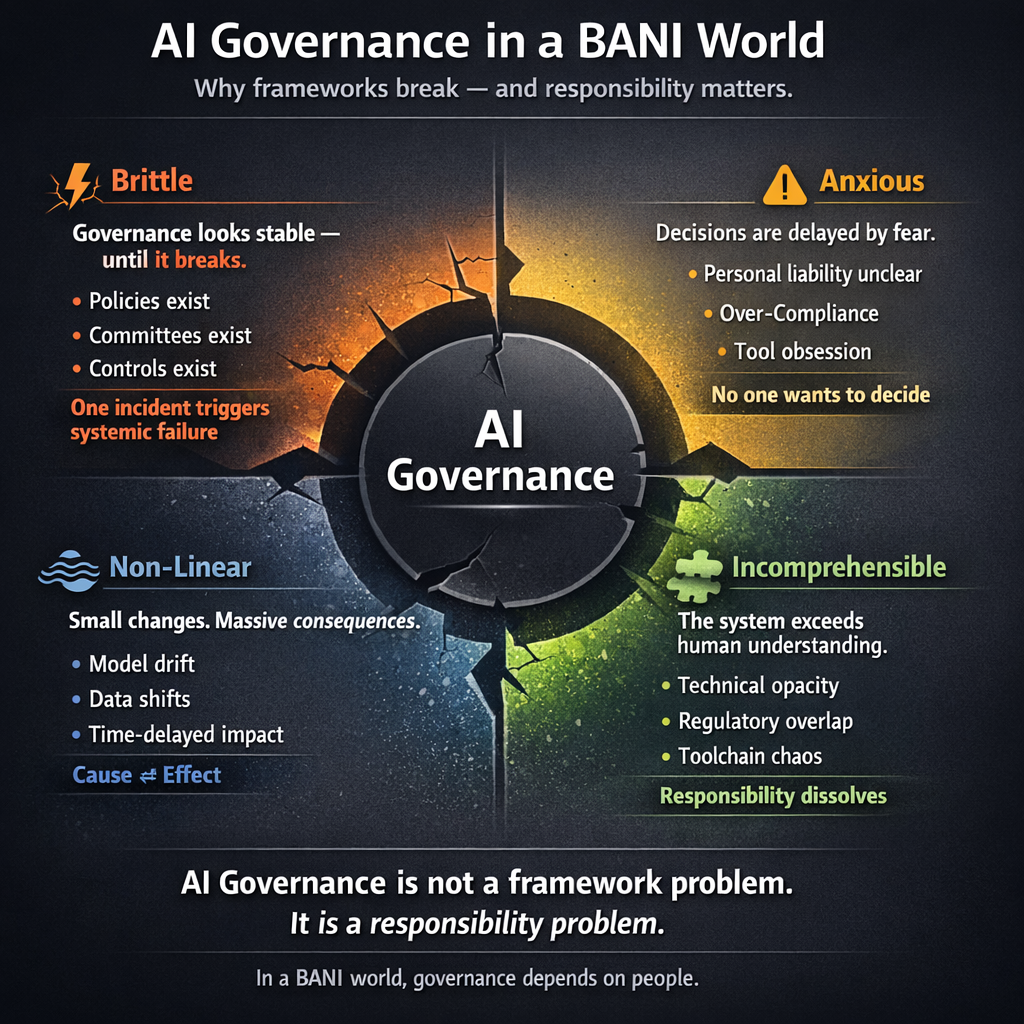
🔍 Brittle.
“We have policies.”
“We have committees.”
“We have controls.”
Everything looks stable — until a single incident exposes how fragile it really is.
🔍 Anxious.
Decisions are delayed.
Not because people don’t understand the issue, but because they fear the consequences.
Personal liability is unclear.
Over-compliance replaces judgment.
In the end, no one wants to decide.
🔍 Non-linear.
A minor model change.
A subtle data shift.
And months later, a major impact no one can fully explain.
Cause and effect drift apart — and responsibility drifts with them.
🔍 Incomprehensible.
Toolchains grow uncontrollably.
Regulatory requirements overlap.
Technical complexity exceeds human understanding.
The more complex the system becomes, the more responsibility dissolves.
This is where AI governance breaks down today.
Not because frameworks are missing.
Not because policies don’t exist.
But because responsibility disappears at the moment it matters most.
📌 My key takeaway from these conversations:
AI governance is not a framework problem.
It is a responsibility problem.
In a BANI world, governance only works when it is clear:
👉 who decides
👉 who is accountable
👉 who is willing to stand behind the decision
Frameworks can support.
Tools can help.
But governance ultimately depends on people.
In practice, the hardest part of AI governance today is not defining rules —
it is making sure someone can actually take responsibility when rules are tested.
Or, as Churchill put it:
Fear is a reaction. Responsibility is a decision.