


The 8-Layer System Behind AIGN OS
From Law to Architecture – How AIGN OS turns regulation into measurable design.
AI governance can no longer rely on policies and principles alone.
It needs architecture — a structured, repeatable, certifiable system that transforms obligations into operational control.
This page explains how AIGN OS is built, why its 8-Layer Architecture defines the world’s first Systemic Governance Operating System, and how it enables measurable, certifiable trust.
What Is the AIGN OS Governance Architecture?
The AIGN OS Architecture is a modular, layered governance system that connects law, leadership, operations, and trust — from boardroom decisions to data pipelines.
It is not a software stack.
It is governance infrastructure — a codified system of roles, legal mappings, frameworks, and verification toolchains.
Each layer serves a specific purpose in governing AI responsibly under the EU AI Act, ISO/IEC 42001, GDPR, NIST AI RMF, and related frameworks.
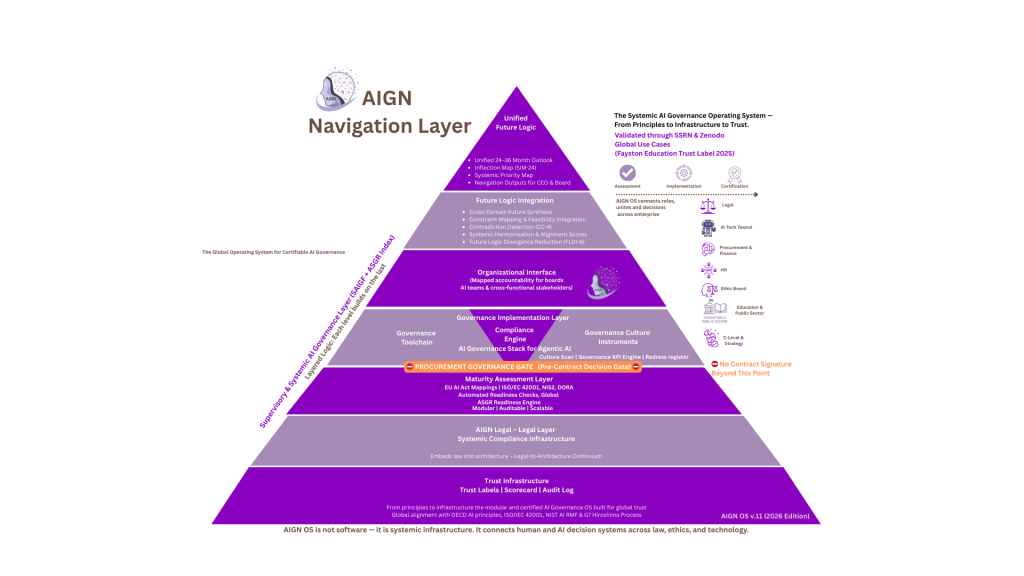
The 8 Layers of AIGN OS
Understanding the Layers
Just like a digital operating system, AIGN OS organises governance in interdependent layers — from principles to oversight, from law to certification.
This architecture makes governance auditable, updateable, and scalable across all contexts.
| Layer | Purpose | Description |
|---|---|---|
| 1 · Trust Infrastructure | Foundation of assurance | Provides the audit-ready base: trust labels, verification registries, audit logs, and accountability evidence. |
| 2 · AIGN Legal Layer (Systemic Compliance Infrastructure) | Law → Architecture | Maps EU AI Act, GDPR, ISO 42001, NIST RMF, OECD Principles into operational governance controls — the Legal-to-Architecture Continuum™. |
| 3 · Maturity Assessment Layer | Readiness & Measurement | Uses the ASGR Index and automated diagnostics to quantify systemic AI governance maturity across regions and sectors. |
| 4 · Governance Implementation Layer | Operations & Processes | Combines Compliance Engine + Governance Toolchains – translating duties into daily workflows, escalation paths, and audit-ready routines. |
| 5 · Organisational Interface | People & Roles | Connects governance to real actors – boards, legal, data, and AI teams; defines fiduciary responsibilities, decision rights, and oversight logic. |
| 6 · Framework Modules | Contextual Governance | Seven modular frameworks – Global, Education, SME, Agentic AI, Data, Culture, Supervisory – all aligned with global regulatory regimes. |
| 7 · Trust Kernel – Foundations of Responsible AI | Ethical & Normative Core | Codifies design principles: human-centricity, accountability, redress, fairness, and systemic transparency. |
| 8 · Supervisory AI Governance Layer (SAIGF) | Oversight & Certification | Embeds board-level fiduciary control – Annual AI Governance Statements, SAIGF Maturity Certificates, and regulator-ready evidence. |
Why a Layered Design?
AI governance is not linear.
Legal, ethical, and operational duties must work in parallel.
The layered model ensures that:
- Governance is continuous — from design to decommissioning
- Each layer is interoperable with global standards
- Compliance is traceable and auditable
- Readiness and certification are measurable
- Trust is built-in, not added-on
How the Layers Work Together
Think of AIGN OS like a systemic control loop:
| Flow | From → To | Function |
|---|---|---|
| Law → Architecture | via the AIGN Legal Layer | Legal texts become actionable governance structures. |
| Readiness → Control | via the ASGR Layer & Governance Implementation | Maturity diagnostics feed directly into governance improvement. |
| Oversight → Trust | via SAIGF & Trust Infrastructure | Board assurance connects to public trust labels and certification. |
| Principles → Practice | via Framework Modules & Toolchains | Ethical, educational, and sectoral frameworks operationalise values. |
Why It’s Globally Deployable
- Modular: Start with one layer or one framework — and expand
- Tool-agnostic: Works with your stack — from SAP to Notion
- Multilingual: Localizable toolkits and guides
- Certifiable: All layers feed into audit readiness and certification
- Low-code ready: Can be embedded into Airtable, M365, Google Workspace, etc.
What’s Inside the Architecture?
| Component | Description |
|---|---|
| 7 Governance Frameworks | Global, Education, SME, Agentic AI, Data, Culture, Supervisory (Governance for Boards). |
| Toolchain & Templates | 40 + assets: policies, risk logs, KPI kits, incident playbooks, ethical prompts. |
| Readiness Diagnostics | 3-stage ASGR-based assessments for governance maturity and resilience. |
| Trust Labels & Certificates | Global Trust Label, Education Trust Label, SAIGF Certificate, Agentic Verified Badge. |
| Legal Mapping | Integrated alignment with EU AI Act, GDPR, Data Act, ISO 42001, NIST AI RMF, OECD Principles. |
| Governance Boards | Configurable board templates for AI risk oversight and reporting structures. |
Summary
AIGN OS is not a framework to adopt — it is an architecture to operate.
Its 8-Layer Design makes governance deployable, auditable, and certifiable —
from the boardroom to the classroom, from enterprise to education, from policy to infrastructure.
By integrating AIGN Legal, ASGR, and SAIGF, the architecture ensures that every legal duty, ethical principle, and operational process is connected, measurable, and verifiable.
Legal Notice on Intellectual Property
© 2025 Patrick Upmann · AIGN – Artificial Intelligence Governance Network
All terminology, structures, frameworks, and the layered architecture of AIGN OS are protected intellectual property under international law (Berne Convention & WIPO Treaty).
Published as DOI-registered scientific work, establishing prior art, scientific recognition, and enforceable authorship.
Unauthorised reproduction or commercial use without written consent is prohibited.
© Patrick Upmann – All rights reserved.