

The AI Governance Operating System for Classification, Evidence & Defensible Trust.
AIGN OS 4.0 helps organisations classify AI systems before compliance, audit and liability questions arrive — turning AI adoption into accountable, evidence-based governance.
Most organisations are deploying AI faster than they can classify it.
The new AI governance challenge is not only policy. It is operational classification: Which AI systems exist? What is their intended purpose? Which systems trigger prohibited-use concerns, transparency duties, high-risk obligations, FRIA, EU database registration or provider responsibility?
AI use is already inside workflows.
Copilots, SaaS tools, HR systems, analytics, procurement workflows, customer service and agentic automations are often deployed before governance evidence exists.
Roles are hired before the operating model exists.
A person is not a governance system. A policy is not a control. A framework is not accountability.
Boards need evidence, not reassurance.
When auditors, regulators or stakeholders ask questions, organisations must show classification logic, responsibility, active controls and defensible records.
From AI adoption to classified, evidence-based and defensible governance.
Choose a focused entry point or combine modules into a full AI Governance Operating Model Sprint. Each module produces concrete governance artefacts, not generic advice.
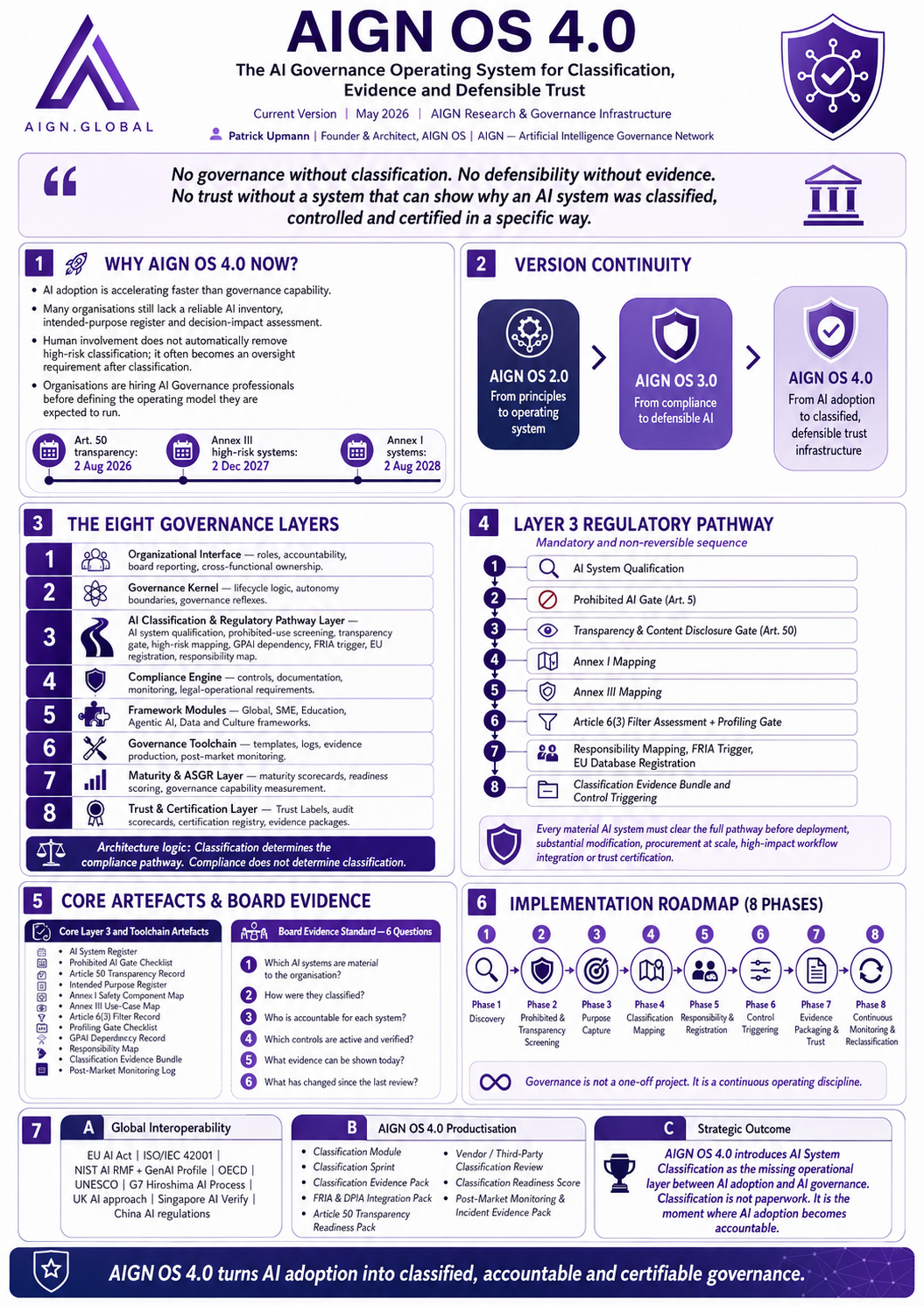
No governance without classification. No defensibility without evidence. No trust without a system that can show why an AI system was classified, controlled and certified in a specific way.
The eight-layer AI Governance Operating System.
From organisational interface to trust certification — every layer produces evidence, controls and accountability that withstand board, audit and regulatory scrutiny.
Organizational Interface
Roles, accountability, AI officer interfaces, RACI, board reporting and escalation ownership.
Governance Kernel
Lifecycle logic, autonomy boundaries, governance reflexes and escalation principles.
AI Classification & Regulatory Pathway Layer
AI qualification, prohibited-use screening, Article 50, high-risk mapping, GPAI, FRIA, EU registration and responsibility mapping.
Compliance Engine
Triggered obligations become controls, documentation, DPIA+, monitoring and operational requirements.
Framework Modules
Global, SME, Education, Agentic AI, Data and Culture modules translate the OS into context.
Governance Toolchain
Registers, evidence bundles, incident scripts, monitoring logs and technical documentation.
Maturity & ASGR Layer
Classification readiness, maturity scoring and systemic governance capability measurement.
Trust & Certification Layer
Trust Labels, audit scorecards, certification registry, evidence packages and external verification readiness.
Turn AIGN OS 4.0 into implementation, evidence and revenue protection.
Each module produces concrete governance artefacts — not generic advice. Combine modules into a full AI Governance Operating Model Sprint.
AIGN OS 4.0 Executive Briefing
A board-level orientation on classification, accountability, evidence and the 2026–2028 AI governance window.
- 90–120 minute executive session
- Classification risk overview
- Board evidence questions
- Management-ready next steps
AI System Classification Sprint
Classify 5–20 AI use cases and create the evidence required for regulatory pathway decisions.
- AI System Register
- Prohibited & Transparency Gates
- Annex I / III Mapping
- Responsibility Map & Evidence Bundle
Vendor AI Governance Review
Assess AI suppliers before procurement, deployment, contract renewal or integration into critical workflows.
- Vendor evidence questionnaire
- Intended purpose review
- Provider/deployer shift analysis
- Contract risk questions
FRIA & DPIA Integration Pack
Connect AI Act fundamental-rights analysis with GDPR DPIA logic and affected-person information pathways.
- FRIA trigger assessment
- FRIA execution template
- DPIA integration record
- Affected-person explanation path
Technical Documentation & Conformity Pack
Prepare high-risk AI systems for technical documentation, conformity pathway decisions and audit-ready records.
- Conformity assessment pathway
- Technical documentation gate
- Data governance evidence sheet
- Human oversight design record
AI Governance Operating Model Sprint
Build the operating model around classification logic, ownership, controls, evidence and board reporting.
- Role architecture map
- Control ownership model
- Evidence infrastructure
- Escalation & reporting paths
Twelve evidence dimensions for defensible AI governance.
AIGN OS 4.0 produces the evidence base required for boards, auditors, procurement teams, regulators and trust-label readiness.
Built for organisations that need AI governance to survive real scrutiny.
Designed for management teams and professional functions that need a practical operating model — not another abstract AI ethics document.
Boards & Audit Committees
Understand which AI systems are material, how they were classified, who is accountable and what evidence can be produced today.
Legal, Risk & Compliance
Translate AI Act classification, Article 50, FRIA, data governance and provider/deployer roles into operational controls.
Procurement & Vendor Management
Assess vendor AI systems before purchasing, integrating or scaling AI-enabled software inside the organisation.
AI Officers & Governance Leads
Operate a practical governance model with registers, evidence bundles, monitoring logs, incident records and reporting routines.
HR, EdTech & High-Impact Functions
Classify sensitive use cases where AI affects people, opportunity, access, performance, assessment or decision support.
SaaS, AI Vendors & Product Teams
Prepare product evidence, intended-purpose clarity, documentation, conformity pathway decisions and trust-readiness.
The 8-phase route from discovery to defensible trust.
Discovery
Identify AI systems, AI-enabled tools, agents, vendor systems, shadow AI and high-impact workflows.
Prohibited & Transparency Screening
Run Prohibited AI Gate and Article 50 Transparency Gate before high-risk assessment.
Purpose Capture
Document intended purpose, operational use, limitations and decision influence.
Classification Mapping
Map systems against Annex I, Annex III, safety component logic, GPAI dependency and filter pathways.
Responsibility & Registration
Determine provider/deployer roles, FRIA triggers and EU database registration obligations.
Control Triggering
Activate compliance controls and governance frameworks based on classification outcomes.
Evidence & Trust
Create the classification evidence bundle, readiness score and trust pathway.
Monitoring & Reclassification
Monitor drift, incidents, model updates, vendor changes and regulatory change continuously.
Start with the AIGN OS 4.0 Executive Briefing.
A focused entry point for leadership teams that need to understand their AI classification, evidence and accountability exposure.
From advisory projects to scalable governance infrastructure.
AIGN OS 4.0 can be delivered as a project, embedded as an internal enterprise method, licensed to implementation partners or connected to AIGN Trust Label readiness.
Enterprise License
For organisations using AIGN OS internally across functions, regions or AI system portfolios.
- Internal use of AIGN OS artefacts
- Classification and evidence method
- Governance operating model support
Partner License
For consultancies and implementation partners applying AIGN OS in client engagements.
- Partner use rights
- AIGN OS method training
- Quality and evidence alignment
Trust Label Readiness
For AI vendors, institutions and organisations preparing evidence-based trust verification.
- Twelve evidence dimensions
- Audit and certification readiness
- Annual renewal options
Classify your AI systems before compliance, audit and liability questions arrive.
AIGN OS 4.0 helps organisations move from AI adoption to classification, from classification to governance, from governance to evidence, and from evidence to trusted certification.