

Embedding AI Oversight into the Boardroom
The Supervisory AI Governance Framework (SAIGF) closes the most pressing gap in corporate governance:
How can Supervisory Boards, Directors, and Committees translate liability, regulatory duties, and investor expectations into concrete, certifiable oversight systems for Artificial Intelligence?
Context & Urgency
- Fiduciary Duty: Landmark rulings like Caremark (US) and ARAG/Garmenbeck (Germany) require Boards to actively monitor “mission-critical risks” – AI is now part of that category.
- Regulation: The EU AI Act, NIS2, DORA, the UK Corporate Governance Code (2024), and ISO/IEC 42001 make AI oversight a Board-level obligation.
- Capital Markets: 72% of S&P 500 firms referenced AI in their 10-Ks; AI-related risk disclosures surged +473% in Fortune 500 filings (2024). Investors expect audit-ready governance.
Purpose of SAIGF
- Recognize AI as a Board mandate, not a management detail.
- Establish AI Governance Literacy for Boards™ – comparable to financial literacy.
- Introduce concrete Oversight Instruments like AI Risk Dashboards, Quarterly Governance Reports, and Escalation Playbooks.
- Ensure Assurance & Certification aligned with EU AI Act, ISO/IEC 42001, NIST AI RMF.
- Deliver Transparency through an Annual AI Governance Statement.
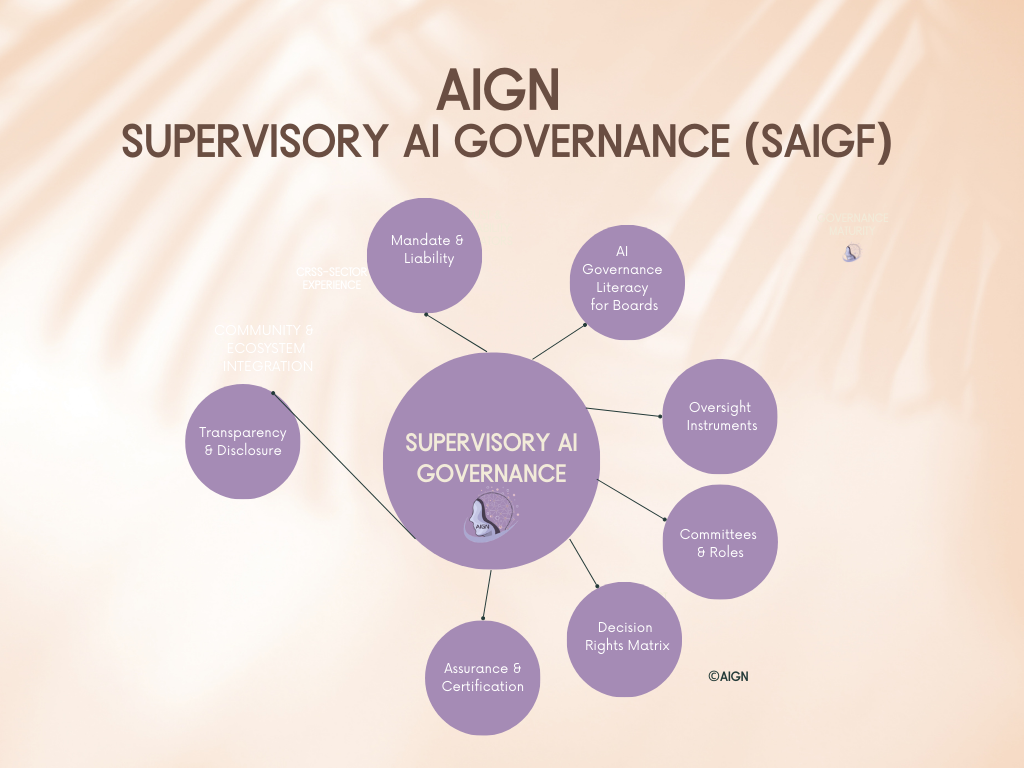
SAIGF Architecture – Core Components
- Mandate & Liability – AI as material enterprise risk.
- AI Governance Literacy for Boards™ – baseline competence and certification.
- Oversight Instruments – dashboards, quarterly reports, escalation playbooks.
- Committees & Roles – integration into Audit/Risk Committees or dedicated AI Committees.
- Decision Rights Matrix™ – clarifying Board vs. management responsibilities.
- Assurance & Certification – audit kits, assurance modules, external validation.
- Transparency & Disclosure – Annual AI Governance Statement.
Core Tools & Artefacts
- AIGN Board AI Risk Dashboard™
- Quarterly AI Governance Report Template
- Board AI Decision Rights Matrix™
- Incident & Escalation Playbook
- AI Governance Literacy Curriculum & Certificate
Strategic Value
- For Boards: liability protection, competence, reputation safeguard.
- For Regulators: evidence of effective oversight, alignment with mandates.
- For Enterprises: investor trust, ESG strength, competitive advantage.
- For Stakeholders: transparency, accountability, trust in AI governance.
Differentiation
- World’s first Board-specific framework for AI oversight.
- Audit-ready and certifiable – not just advisory.
- Protected IP (AI Governance Literacy for Boards™, Board AI Risk Dashboard™, Decision Rights Matrix™).
- Integration into AIGN OS as a supervisory governance layer.
Scaling & Implementation
- Board Pack: ready-to-deploy tools for the next committee cycle.
- Certification: Certified AI Governance Board Member™.
- Assurance Pathways: self-assessment, internal audit, external certification.
- Global Rollout: mandated in Europe (AI Act, UK Code), expanding to the US and Asia, standardization by 2030.
Board Readiness Maturity Model
- Level 1 – Ad Hoc → no structured oversight.
- Level 3 – Structured → foundational governance in place.
- Level 5 – Transformative → certified, global leadership in AI oversight.
Conclusion
The AIGN Supervisory AI Governance Framework (SAIGF) represents the OECD moment for AI oversight:
From liability to leadership.
From fragmented awareness to a certifiable oversight system.
Supervisory Boards, regulators, and enterprises can adopt SAIGF today – as the world’s first global standard for Board-level AI Governance.
Legal Notice on Intellectual Property
All content, structures, frameworks, terminologies, and the layered governance architecture of AIGN OS – The AI Governance Operating System are the original intellectual creation of Patrick Upmann. AIGN OS and all its components – including but not limited to frameworks, toolchains, trust labels, indices, licensing models, and governance architectures – are protected under international copyright, trademark, and intellectual property law.
The AIGN OS concept and system have been officially published DOI-registered research paper as citable scientific work, thereby establishing prior art, scientific recognition, and enforceable authorship protection.Any unauthorized reproduction, adaptation, distribution, modification, or commercial/public use of AIGN OS – in whole or in part – without the express written consent of the rights holder is strictly prohibited and will result in legal enforcement under applicable international IP law.
© Patrick Upmann – All rights reserved.