

AIGN Research: Governing machine authority in high-consequence systems.
Applied research on machine authority, defensible autonomy and AI governance in critical infrastructure, early warning and other high-consequence environments.
From governance principles to operational models for AI-enabled systems that can inform, decide and act.
Machine authority · Runtime governance · Evidence · Critical infrastructure
Research at the boundary between intelligence and authority
Artificial intelligence is moving beyond generating information. AI-enabled systems increasingly support operational decisions, interact with digital and physical infrastructure, and take actions with real-world consequences. Technical capability is not authorised action: capability is what a machine can do, authority is what an organisation permits it to do.
This raises the central research question:
Under what conditions may an AI-enabled system act without real-time human confirmation, while human accountability remains clearly anchored?
The AIGN Research question
AIGN Research studies the authority, accountability and evidence structures needed to govern such systems. The work connects AI governance, operational risk, technical control mechanisms and institutional oversight, with particular attention to environments where system behaviour may affect public safety, essential services or organisational continuity. Neither more autonomy nor more human intervention is treated as preferable in itself: delegated authority is designed and assessed by context, consequence, time criticality and the ability to keep effective control and accountability.
Core research areas
Four conceptual research fields define what AIGN Research investigates, each addressing a distinct question. The critical infrastructure domains below provide application contexts for these research questions.
Machine authority and defensible autonomy
What authority may an AI-enabled system be granted in the first place? Topics include operational mandates, delegated authority, authority boundaries, human accountability anchors and evidence of authorised behaviour.
Operational AI governance in critical infrastructure
How is that authority embedded into real organisations, processes and systems once it is granted, especially where AI-supported decisions may have physical, societal or systemic consequences? Topics include decision ownership, monitoring and early warning, escalation and human intervention, and accountability for consequential actions.
Runtime governance and evidence
How is that authority technically enforced and evidenced while a system operates? Topics include policy enforcement, monitoring, intervention mechanisms, logging, auditability and the reconstruction of consequential system actions.
Cross-border and cross-sector governance
How does accountability hold when authority crosses institutional boundaries? Topics include AI-enabled systems where data, decisions and consequences cross organisational, sectoral or national lines, distributed accountability, institutional coordination and shared operational authority.
Open research questions
Working hypothesis: consequential machine authority is defensible only when three things stay aligned under real operating conditions. Mandated authority is what the responsible institution has explicitly permitted. Executable authority is what the machine can actually do through its tools, credentials, integrations and delegated agents. Enforced authority is what technical and operational mechanisms prevent, constrain, interrupt or record outside the mandate.
Hypotheses under development; no results are claimed. Set out in The AI Governance Gap Brief, issue #35 (September 2026).
Further questions across the research areas: how machine authority can be formally specified, constrained and revoked; how governance requirements can be enforced during operation rather than assessed only retrospectively; and how institutional accountability can be maintained across interconnected AI systems and organisational boundaries.
Critical infrastructure research domains
AIGN Research examines the governance of AI-enabled systems across critical infrastructure, essential services and other high-consequence environments.
Its research agenda addresses seven interconnected application domains in which delegated machine authority, operational resilience and human accountability are particularly consequential.
-
Energy & power systems
AI governance in electricity networks, generation assets, grid operations and energy infrastructure.
Research focus: machine authority in operational control, response boundaries, incident escalation and accountability for consequential actions.
-
Water & environmental infrastructure
Governance of AI-enabled monitoring, risk assessment and operational decision support in water and environmental systems.
Research focus: authority allocation, human intervention, reliability and evidence in time-critical situations.
-
Digital & telecommunications infrastructure
Governance of autonomous operations across telecommunications networks, cloud infrastructure and digital services.
Research focus: delegated operational authority, cross-system dependencies, runtime controls and recoverability.
-
Financial & payment infrastructure
Machine authority in financial operations, payments, automated control systems and essential financial services.
Research focus: transaction authority, operational resilience, human accountability and auditability.
-
Transport & mobility
AI governance across intelligent transport networks, rail, logistics and operational mobility systems.
Research focus: autonomous coordination, safety boundaries, intervention mechanisms and system-level accountability.
-
Industrial & cyber-physical systems
Governance of AI-enabled industrial processes, operational technology and systems capable of producing physical effects.
Research focus: bounded machine action, safety-critical controls, human override and evidence.
-
Civil preparedness & emergency response
Governance of AI-enabled monitoring, early warning, crisis response and systems operating across institutional boundaries.
Research focus: delegated authority, escalation, distributed accountability and governance under time pressure.
Research approach
AIGN Research combines conceptual research, regulatory analysis and applied governance architecture to investigate the conditions under which AI-enabled systems may exercise consequential authority. Hypotheses are tested through reference scenarios, architecture tests, expert validation and documented edge cases. Its methodological approach encompasses:
- Conceptual analysis
Examining machine authority, delegated decision-making and human accountability.
- Scenario-based investigation
Analysing operational conditions, authority boundaries and the consequences of autonomous action, including documented edge cases.
- Governance architecture
Developing models for operational mandates, runtime controls and reconstructable evidence.
- Regulatory analysis
Examining the relationship between governance requirements, applicable regulation and operational implementation.
- Applied validation
Evaluating proposed governance models against relevant operational requirements and practical constraints, through expert validation where suitable evidence and stakeholder access are available.
Status: AIGN Critical OS is a published, standalone architecture contribution (mandate, identity, authority envelope, human accountability, runtime enforcement, human intervention, evidence, change control, revocation). It provides a starting point for investigation, not a predetermined research outcome, and its assumptions are open to review and refinement through research. Public executive preview (PDF)
Outputs: research papers, testable requirements, reference architectures and evaluation protocols, published under DOI where applicable.
The research approach explicitly examines underlying assumptions, operational applicability and limits of generalisation. The objective is not merely to assess individual AI deployments, but to develop and examine governance models that can inform research and practice beyond a single organisational or technological context.
Publications and prior work
AIGN Research builds on Patrick Upmann’s published work. Outputs are labelled by type; peer review is stated only where it has taken place.
Reports, papers and preprints (2026)
- ReportUpmann, P. (2026). AIGN OS 3.0 – The Operating System for Defensible AI Governance. Zenodo, April 2026. doi.org/10.5281/zenodo.19591992
- ReportUpmann, P. (2026). The Control–Liability Paradox in AI Governance: Where AI Liability Actually Begins. Zenodo. doi.org/10.5281/zenodo.19383750
- ReportUpmann, P. (2026). Operationalizing Responsible AI: A Systemic AI Governance Architecture for Organizational Implementation. Zenodo. doi.org/10.5281/zenodo.19047363
- PaperUpmann, P. (2026). AIGN Runtime Economic Governance: Governing AI Cost, Usage and Value in the Token Economy. Zenodo. doi.org/10.5281/zenodo.20638267
- PreprintUpmann, P. (2026). AIGN EOS: Education Operating System for Trustworthy AI Decisions Affecting Children. Zenodo. doi.org/10.5281/zenodo.19450612
- PreprintUpmann, P. (2026). The Geopolitics of AI Governance — AI Governance as a Geopolitical Infrastructure. Zenodo. doi.org/10.5281/zenodo.19064602
- PaperUpmann, P. (2026). AI Slop in the Enterprise: Synthetic Knowledge Amplification and the Governance of Organisational Knowledge Infrastructures. Zenodo, AIGN OS Research. doi.org/10.5281/zenodo.18936597
Working papers (2025) · 12 titles
- Working paperUpmann, P. (2025). AIGN OS — AI Agents: The AI Governance Stack as a New Regulatory Infrastructure. SSRN. doi.org/10.2139/ssrn.5543162
- Working paperUpmann, P. (2025). AIGN OS — Trust Infrastructure: Certification, Licensing, and Market Enforcement for Responsible AI. SSRN. doi.org/10.2139/ssrn.5561078
- Working paperUpmann, P. (2025). AIGN Systemic AI Governance Stress Test. SSRN. doi.org/10.2139/ssrn.5489746
- Working paperUpmann, P. (2025). AIGN — AI Governance Compliance Framework for SAP® S/4HANA. SSRN. doi.org/10.2139/ssrn.5494068
- Working paperUpmann, P. (2025). AIGN OS — The Operating System for Responsible AI Governance. SSRN. doi.org/10.2139/ssrn.5382603
- Working paperUpmann, P. (2025). AIGN — Procurement Governance Gate. Zenodo. doi.org/10.5281/zenodo.17936982
- Working paperUpmann, P. (2025). The AI Navigation Gap: A Cross-Domain Analysis of Why Modern Organizations Cannot Form a Unified Future Logic. Zenodo. doi.org/10.5281/zenodo.17702876
- Working paperUpmann, P. (2025). AIGN OS 2.0 — The Operating System for Responsible AI Governance (Architecture, Compliance & Trust Infrastructure). Zenodo. doi.org/10.5281/zenodo.17659911
- Working paperUpmann, P. (2025). The ASGR Index — Establishing the First Global Benchmark for Systemic AI Governance Readiness. Zenodo. doi.org/10.5281/zenodo.17475315
- Working paperUpmann, P. (2025). The AIGN Declaration on Systemic AI Governance: Defining the Operating Principles for the Age of Intelligent Systems. Zenodo. doi.org/10.5281/zenodo.17481653
- Working paperUpmann, P. (2025). The AIGN Academy — Institutionalizing Systemic AI Governance Education. Zenodo. doi.org/10.5281/zenodo.17462559
- Working paperUpmann, P. (2025). AIGN Legal — From Law to Architecture: Institutionalising Systemic Legal AI Governance. Zenodo. doi.org/10.5281/zenodo.17573539
The AI Governance Operating Series
Concepts and ongoing publications
- Defensible autonomyThe conditions under which AI-enabled systems may exercise delegated authority within defined boundaries, runtime controls and human accountability structures. The author’s own conceptual model, not an established international technical standard.
- The authority supply chainHow authority is granted, transferred, constrained and evidenced across interconnected systems, organisations and jurisdictions. Introduced in The AI Governance Gap Brief, issue 32 (August 2026).
- DARTA proprietary executive test for delegated machine authority: Delegation, Authority, Runtime Control and Traceability. Not a regulatory standard.
- The AI Governance Gap BriefLinkedIn newsletter, one structural governance gap per issue. Latest: issue #38, The Agentic State Gap (November 2026). Subscribe on LinkedIn · All issues
- AI Governance Report 2027 · in preparationAn independent view of AI governance going into 2027 for boards, operators of critical infrastructure and legal, risk and compliance leaders. Get it on release
Complete record: ORCID 0009-0001-6626-8531
Research lead
Patrick Upmann · Founder, AIGN.Global · Research Lead, AIGN Research · Munich
Patrick Upmann is an independent AI governance advisor, keynote speaker and author with more than 25 years of experience in IT governance, risk and compliance, including work across finance, energy, automotive and retail. He is the architect of AIGN OS, AIGN Critical OS and the DART executive test for delegated machine authority, and the author of The AI Governance Operating Series and The AI Governance Gap Brief. His research addresses machine authority, defensible autonomy and governance in high-consequence systems.
Keynotes and engagement
“When AI Systems Begin to Act: Authority, Control and Accountability in Critical Infrastructure”
Plenary Talk 2 at the 16th International Conference on Dependable Systems, Services and Technologies (hybrid). 2026 theme: Dependable, Human‑Aligned and Cyber‑Physical AI Systems for a Safe, Secure and Sustainable World.
The argument: dependable AI asks not only whether a system produces a reliable output, but when it should be authorised to act on it. Related article: The AI Governance Gap Brief, issue #36: The Assurance Authority Gap (hypotheses only; no experimental results are reported).
Advanced Research Workshop, Yerevan
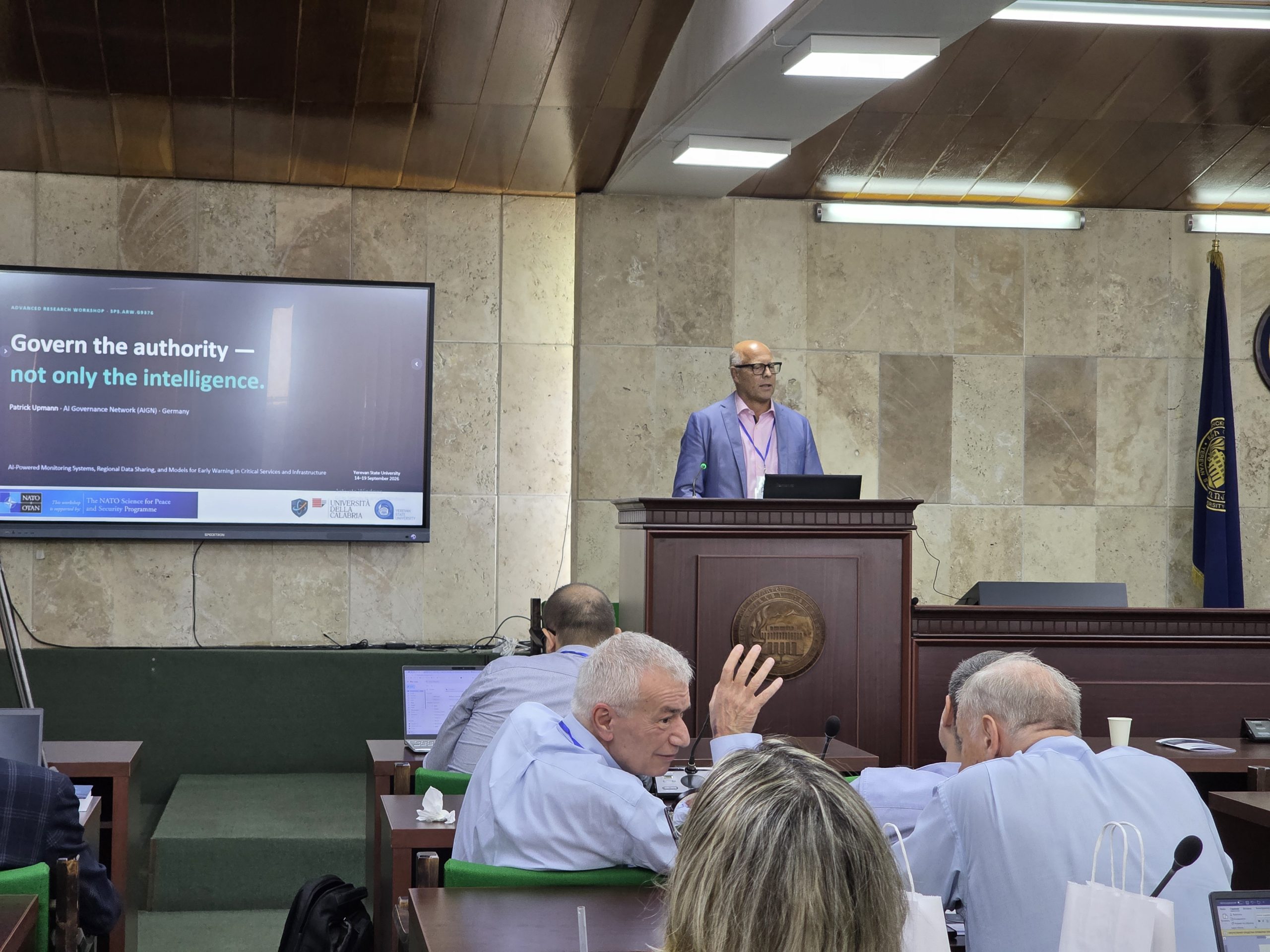
- Workshop: AI-Powered Monitoring Systems, Regional Data Sharing, and Models for Early Warning in Critical Services and Infrastructure, 14–19 September 2026, Yerevan State University, Armenia
- Organisers: CenTRiS Foundation (Armenia) and University of Calabria (Italy), with NATO SPS support under grant ARW.G9376
- Keynote, 16 September (Session 2.2, Governance and trust frameworks): „From innovation to implementation — building governance frameworks for AI in critical sectors“
- Round table co-chair, 17 September: „Toward a regional data-sharing framework for critical infrastructure“, with Prof. Ramaz Kvatadze (GRENA, Georgia)
- Write-up, 22 September: the keynote’s argument, from early warning to authorised action, is developed in The AI Governance Gap Brief, issue #35
This is a documented speaking engagement. It does not constitute NATO endorsement of, or funding for, AIGN Research.
Further speaking engagements
- 2026 · 5th Fintech Week FrankfurtSpeaker and panelist: “AI Governance, Risk & Regulation: From Black Box to Explainable Finance”.
- 2026 · 37th EBS SymposiumEBS University, Germany. Invited to the economic symposium for business, law and leadership.
- 2025 · TRT World ForumIstanbul, Turkey. Invited speaker on AI governance as global infrastructure.
Research & international cooperation
AIGN Research welcomes collaboration with universities, research institutions, critical infrastructure operators and public-sector organisations.
Potential cooperation includes joint research, scenario-based investigations, governance architecture development, applied validation and knowledge transfer.
Research collaborations are developed on the basis of clearly defined objectives, responsibilities, funding, intellectual property arrangements and publication rights.
Project information and research findings are disclosed only where publication has been agreed and applicable confidentiality obligations permit disclosure.
Patrick Upmann · AIGN Research
Germany · International research cooperation
AIGN Research is an applied research initiative of AIGN.Global. The legal entity responsible for this website is named in the legal notice.
Research at the boundary between intelligence and authority
Artificial intelligence is moving beyond generating information. AI-enabled systems increasingly support operational decisions, interact with digital and physical infrastructure, and take actions with real-world consequences. Technical capability is not authorised action: capability is what a machine can do, authority is what an organisation permits it to do.
This raises the central research question:
Under what conditions may an AI-enabled system act without real-time human confirmation, while human accountability remains clearly anchored?
The AIGN Research question
AIGN Research studies the authority, accountability and evidence structures needed to govern such systems. The work connects AI governance, operational risk, technical control mechanisms and institutional oversight, with particular attention to environments where system behaviour may affect public safety, essential services or organisational continuity. Neither more autonomy nor more human intervention is treated as preferable in itself: delegated authority is designed and assessed by context, consequence, time criticality and the ability to keep effective control and accountability.
Core research areas
Four conceptual research fields define what AIGN Research investigates, each addressing a distinct question. The critical infrastructure domains below provide application contexts for these research questions.
Machine authority and defensible autonomy
What authority may an AI-enabled system be granted in the first place? Topics include operational mandates, delegated authority, authority boundaries, human accountability anchors and evidence of authorised behaviour.
Operational AI governance in critical infrastructure
How is that authority embedded into real organisations, processes and systems once it is granted, especially where AI-supported decisions may have physical, societal or systemic consequences? Topics include decision ownership, monitoring and early warning, escalation and human intervention, and accountability for consequential actions.
Runtime governance and evidence
How is that authority technically enforced and evidenced while a system operates? Topics include policy enforcement, monitoring, intervention mechanisms, logging, auditability and the reconstruction of consequential system actions.
Cross-border and cross-sector governance
How does accountability hold when authority crosses institutional boundaries? Topics include AI-enabled systems where data, decisions and consequences cross organisational, sectoral or national lines, distributed accountability, institutional coordination and shared operational authority.
Open research questions
Working hypothesis: consequential machine authority is defensible only when three things stay aligned under real operating conditions. Mandated authority is what the responsible institution has explicitly permitted. Executable authority is what the machine can actually do through its tools, credentials, integrations and delegated agents. Enforced authority is what technical and operational mechanisms prevent, constrain, interrupt or record outside the mandate.
Hypotheses under development; no results are claimed. Set out in The AI Governance Gap Brief, issue #35 (September 2026).
Further questions across the research areas: how machine authority can be formally specified, constrained and revoked; how governance requirements can be enforced during operation rather than assessed only retrospectively; and how institutional accountability can be maintained across interconnected AI systems and organisational boundaries.
Critical infrastructure research domains
AIGN Research examines the governance of AI-enabled systems across critical infrastructure, essential services and other high-consequence environments.
Its research agenda addresses seven interconnected application domains in which delegated machine authority, operational resilience and human accountability are particularly consequential.
-
Energy & power systems
AI governance in electricity networks, generation assets, grid operations and energy infrastructure.
Research focus: machine authority in operational control, response boundaries, incident escalation and accountability for consequential actions.
-
Water & environmental infrastructure
Governance of AI-enabled monitoring, risk assessment and operational decision support in water and environmental systems.
Research focus: authority allocation, human intervention, reliability and evidence in time-critical situations.
-
Digital & telecommunications infrastructure
Governance of autonomous operations across telecommunications networks, cloud infrastructure and digital services.
Research focus: delegated operational authority, cross-system dependencies, runtime controls and recoverability.
-
Financial & payment infrastructure
Machine authority in financial operations, payments, automated control systems and essential financial services.
Research focus: transaction authority, operational resilience, human accountability and auditability.
-
Transport & mobility
AI governance across intelligent transport networks, rail, logistics and operational mobility systems.
Research focus: autonomous coordination, safety boundaries, intervention mechanisms and system-level accountability.
-
Industrial & cyber-physical systems
Governance of AI-enabled industrial processes, operational technology and systems capable of producing physical effects.
Research focus: bounded machine action, safety-critical controls, human override and evidence.
-
Civil preparedness & emergency response
Governance of AI-enabled monitoring, early warning, crisis response and systems operating across institutional boundaries.
Research focus: delegated authority, escalation, distributed accountability and governance under time pressure.
Research approach
AIGN Research combines conceptual research, regulatory analysis and applied governance architecture to investigate the conditions under which AI-enabled systems may exercise consequential authority. Hypotheses are tested through reference scenarios, architecture tests, expert validation and documented edge cases. Its methodological approach encompasses:
- Conceptual analysis
Examining machine authority, delegated decision-making and human accountability.
- Scenario-based investigation
Analysing operational conditions, authority boundaries and the consequences of autonomous action, including documented edge cases.
- Governance architecture
Developing models for operational mandates, runtime controls and reconstructable evidence.
- Regulatory analysis
Examining the relationship between governance requirements, applicable regulation and operational implementation.
- Applied validation
Evaluating proposed governance models against relevant operational requirements and practical constraints, through expert validation where suitable evidence and stakeholder access are available.
Status: AIGN Critical OS is a published, standalone architecture contribution (mandate, identity, authority envelope, human accountability, runtime enforcement, human intervention, evidence, change control, revocation). It provides a starting point for investigation, not a predetermined research outcome, and its assumptions are open to review and refinement through research. Public executive preview (PDF)
Outputs: research papers, testable requirements, reference architectures and evaluation protocols, published under DOI where applicable.
The research approach explicitly examines underlying assumptions, operational applicability and limits of generalisation. The objective is not merely to assess individual AI deployments, but to develop and examine governance models that can inform research and practice beyond a single organisational or technological context.
Publications and prior work
AIGN Research builds on Patrick Upmann’s published work. Outputs are labelled by type; peer review is stated only where it has taken place.
Reports, papers and preprints (2026)
- ReportUpmann, P. (2026). AIGN OS 3.0 – The Operating System for Defensible AI Governance. Zenodo, April 2026. doi.org/10.5281/zenodo.19591992
- ReportUpmann, P. (2026). The Control–Liability Paradox in AI Governance: Where AI Liability Actually Begins. Zenodo. doi.org/10.5281/zenodo.19383750
- ReportUpmann, P. (2026). Operationalizing Responsible AI: A Systemic AI Governance Architecture for Organizational Implementation. Zenodo. doi.org/10.5281/zenodo.19047363
- PaperUpmann, P. (2026). AIGN Runtime Economic Governance: Governing AI Cost, Usage and Value in the Token Economy. Zenodo. doi.org/10.5281/zenodo.20638267
- PreprintUpmann, P. (2026). AIGN EOS: Education Operating System for Trustworthy AI Decisions Affecting Children. Zenodo. doi.org/10.5281/zenodo.19450612
- PreprintUpmann, P. (2026). The Geopolitics of AI Governance — AI Governance as a Geopolitical Infrastructure. Zenodo. doi.org/10.5281/zenodo.19064602
- PaperUpmann, P. (2026). AI Slop in the Enterprise: Synthetic Knowledge Amplification and the Governance of Organisational Knowledge Infrastructures. Zenodo, AIGN OS Research. doi.org/10.5281/zenodo.18936597
Working papers (2025) · 12 titles
- Working paperUpmann, P. (2025). AIGN OS — AI Agents: The AI Governance Stack as a New Regulatory Infrastructure. SSRN. doi.org/10.2139/ssrn.5543162
- Working paperUpmann, P. (2025). AIGN OS — Trust Infrastructure: Certification, Licensing, and Market Enforcement for Responsible AI. SSRN. doi.org/10.2139/ssrn.5561078
- Working paperUpmann, P. (2025). AIGN Systemic AI Governance Stress Test. SSRN. doi.org/10.2139/ssrn.5489746
- Working paperUpmann, P. (2025). AIGN — AI Governance Compliance Framework for SAP® S/4HANA. SSRN. doi.org/10.2139/ssrn.5494068
- Working paperUpmann, P. (2025). AIGN OS — The Operating System for Responsible AI Governance. SSRN. doi.org/10.2139/ssrn.5382603
- Working paperUpmann, P. (2025). AIGN — Procurement Governance Gate. Zenodo. doi.org/10.5281/zenodo.17936982
- Working paperUpmann, P. (2025). The AI Navigation Gap: A Cross-Domain Analysis of Why Modern Organizations Cannot Form a Unified Future Logic. Zenodo. doi.org/10.5281/zenodo.17702876
- Working paperUpmann, P. (2025). AIGN OS 2.0 — The Operating System for Responsible AI Governance (Architecture, Compliance & Trust Infrastructure). Zenodo. doi.org/10.5281/zenodo.17659911
- Working paperUpmann, P. (2025). The ASGR Index — Establishing the First Global Benchmark for Systemic AI Governance Readiness. Zenodo. doi.org/10.5281/zenodo.17475315
- Working paperUpmann, P. (2025). The AIGN Declaration on Systemic AI Governance: Defining the Operating Principles for the Age of Intelligent Systems. Zenodo. doi.org/10.5281/zenodo.17481653
- Working paperUpmann, P. (2025). The AIGN Academy — Institutionalizing Systemic AI Governance Education. Zenodo. doi.org/10.5281/zenodo.17462559
- Working paperUpmann, P. (2025). AIGN Legal — From Law to Architecture: Institutionalising Systemic Legal AI Governance. Zenodo. doi.org/10.5281/zenodo.17573539
The AI Governance Operating Series
Concepts and ongoing publications
- Defensible autonomyThe conditions under which AI-enabled systems may exercise delegated authority within defined boundaries, runtime controls and human accountability structures. The author’s own conceptual model, not an established international technical standard.
- The authority supply chainHow authority is granted, transferred, constrained and evidenced across interconnected systems, organisations and jurisdictions. Introduced in The AI Governance Gap Brief, issue 32 (August 2026).
- DARTA proprietary executive test for delegated machine authority: Delegation, Authority, Runtime Control and Traceability. Not a regulatory standard.
- The AI Governance Gap BriefLinkedIn newsletter, one structural governance gap per issue. Latest: issue #38, The Agentic State Gap (November 2026). Subscribe on LinkedIn · All issues
- AI Governance Report 2027 · in preparationAn independent view of AI governance going into 2027 for boards, operators of critical infrastructure and legal, risk and compliance leaders. Get it on release
Complete record: ORCID 0009-0001-6626-8531
Research lead
Patrick Upmann · Founder, AIGN.Global · Research Lead, AIGN Research · Munich
Patrick Upmann is an independent AI governance advisor, keynote speaker and author with more than 25 years of experience in IT governance, risk and compliance, including work across finance, energy, automotive and retail. He is the architect of AIGN OS, AIGN Critical OS and the DART executive test for delegated machine authority, and the author of The AI Governance Operating Series and The AI Governance Gap Brief. His research addresses machine authority, defensible autonomy and governance in high-consequence systems.
Keynotes and engagement
“When AI Systems Begin to Act: Authority, Control and Accountability in Critical Infrastructure”
Plenary Talk 2 at the 16th International Conference on Dependable Systems, Services and Technologies (hybrid). 2026 theme: Dependable, Human‑Aligned and Cyber‑Physical AI Systems for a Safe, Secure and Sustainable World.
The argument: dependable AI asks not only whether a system produces a reliable output, but when it should be authorised to act on it. Related article: The AI Governance Gap Brief, issue #36: The Assurance Authority Gap (hypotheses only; no experimental results are reported).
Advanced Research Workshop, Yerevan
- Workshop: AI-Powered Monitoring Systems, Regional Data Sharing, and Models for Early Warning in Critical Services and Infrastructure, 14–19 September 2026, Yerevan State University, Armenia
- Organisers: CenTRiS Foundation (Armenia) and University of Calabria (Italy), with NATO SPS support under grant ARW.G9376
- Keynote, 16 September (Session 2.2, Governance and trust frameworks): „From innovation to implementation — building governance frameworks for AI in critical sectors“
- Round table co-chair, 17 September: „Toward a regional data-sharing framework for critical infrastructure“, with Prof. Ramaz Kvatadze (GRENA, Georgia)
- Write-up, 22 September: the keynote’s argument, from early warning to authorised action, is developed in The AI Governance Gap Brief, issue #35
This is a documented speaking engagement. It does not constitute NATO endorsement of, or funding for, AIGN Research.
Further speaking engagements
- 2026 · 5th Fintech Week FrankfurtSpeaker and panelist: “AI Governance, Risk & Regulation: From Black Box to Explainable Finance”.
- 2026 · 37th EBS SymposiumEBS University, Germany. Invited to the economic symposium for business, law and leadership.
- 2025 · TRT World ForumIstanbul, Turkey. Invited speaker on AI governance as global infrastructure.
Research & international cooperation
AIGN Research welcomes collaboration with universities, research institutions, critical infrastructure operators and public-sector organisations.
Potential cooperation includes joint research, scenario-based investigations, governance architecture development, applied validation and knowledge transfer.
Research collaborations are developed on the basis of clearly defined objectives, responsibilities, funding, intellectual property arrangements and publication rights.
Project information and research findings are disclosed only where publication has been agreed and applicable confidentiality obligations permit disclosure.
Patrick Upmann · AIGN Research
Germany · International research cooperation
AIGN Research is an applied research initiative of AIGN.Global. The legal entity responsible for this website is named in the legal notice.