From Principles to Systemic AI Governance Architecture
Artificial Intelligence is rapidly transforming how organizations make decisions, automate processes, and design digital services. From generative AI assistants to autonomous decision systems, AI is becoming a core infrastructure of the modern economy.
At the same time, governments and regulators around the world are introducing new governance frameworks to ensure that AI systems are deployed responsibly. Initiatives such as the EU AI Act, ISO/IEC 42001, the NIST AI Risk Management Framework, and the OECD AI Principles are defining the emerging global standards for trustworthy and accountable AI.
Yet despite the growing number of governance frameworks and ethical guidelines, many organizations face a fundamental challenge:
How can responsible AI principles be translated into operational governance structures that actually guide the development, deployment, and monitoring of AI systems?
In practice, AI governance often remains abstract. Companies publish ethical principles, compliance teams interpret regulations, and technical teams develop AI systems — but the organizational structures that connect leadership accountability, decision ownership, regulatory classification, technical safeguards, and monitoring processes are frequently missing.
This gap between AI governance principles and real operational governance is one of the central challenges of responsible AI implementation.
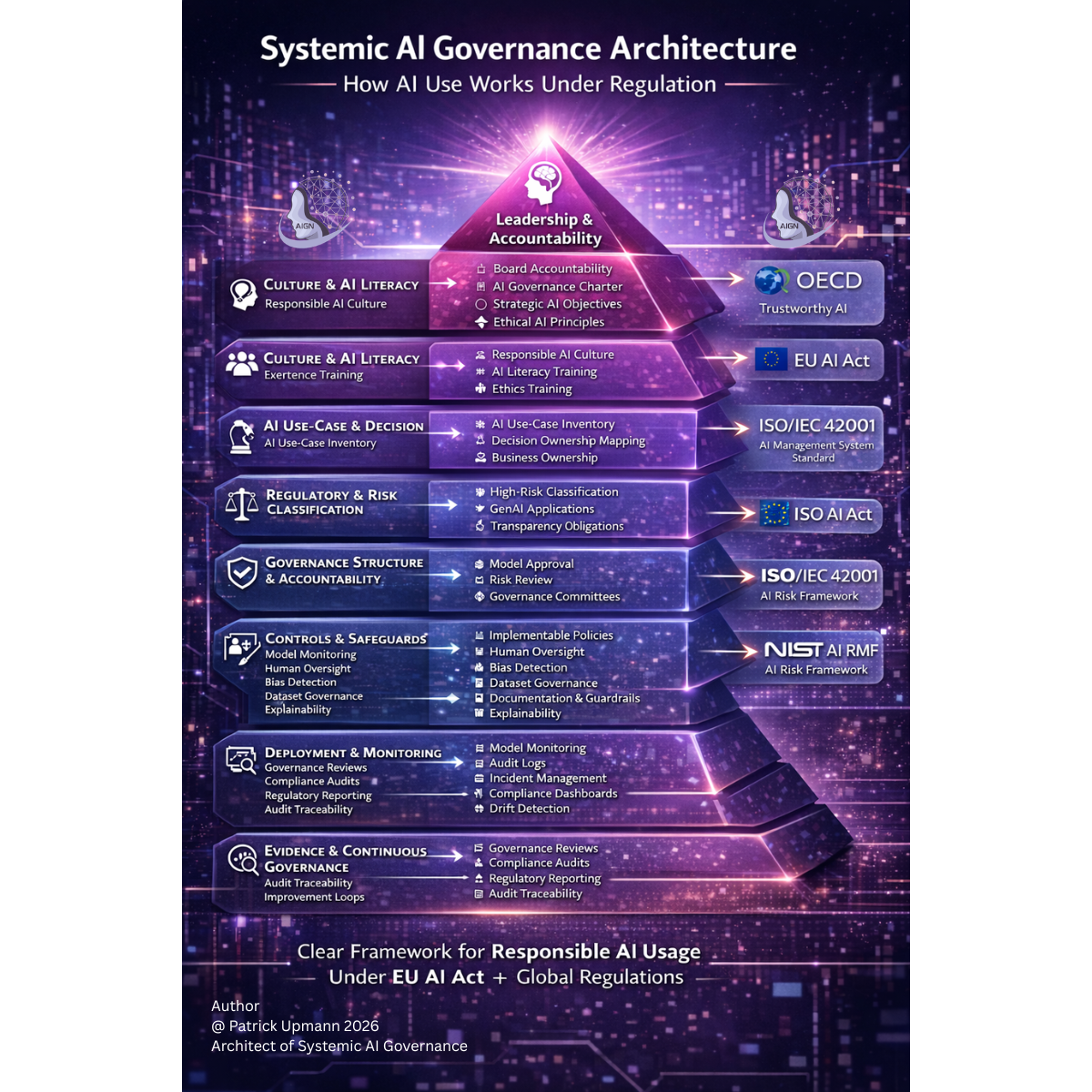
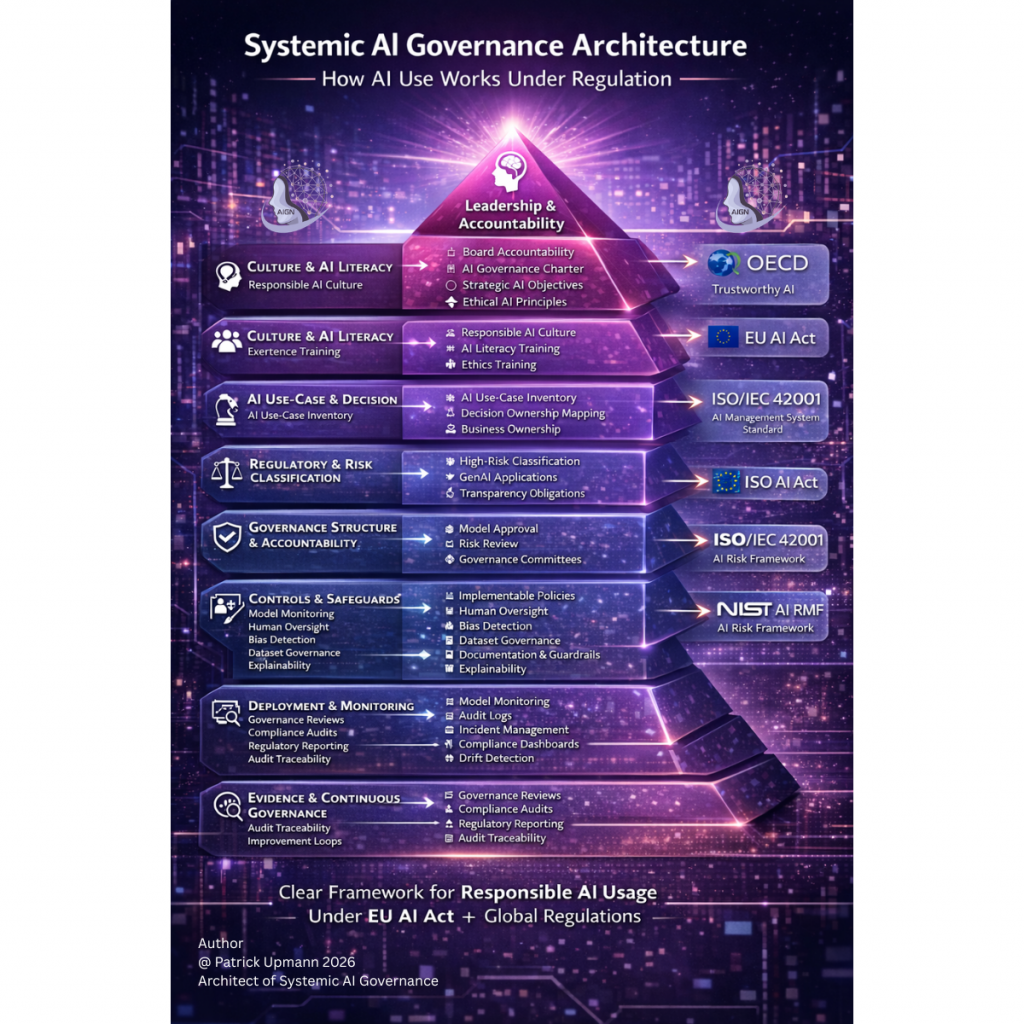
The Systemic AI Governance Architecture, developed as part of the AIGN OS research program, addresses this challenge by providing a structured operational model for implementing responsible AI within organizations. The architecture organizes AI governance across eight interconnected operational layers, forming a governance lifecycle that connects strategy, culture, risk management, technical safeguards, and continuous governance monitoring.
By translating governance principles into a systemic governance architecture, organizations can move from abstract responsible AI commitments toward practical, accountable, and scalable AI governance implementation.
The Eight Operational Layers of AI Governance
The architecture organizes responsible AI implementation into eight interconnected governance layers that together form a complete governance lifecycle.
1. Leadership & Accountability
AI governance begins at the leadership level.
Organizations must establish clear governance mandates and strategic direction for AI adoption.
Key components include:
- Board-level accountability for AI
- AI governance charters
- Ethical AI principles
- Strategic AI governance objectives
Leadership provides the institutional authority that enables governance across the organization.
2. Culture & AI Literacy
Governance cannot function without organizational capability.
Employees and decision makers must understand:
- how AI systems work
- what risks AI introduces
- what responsibilities come with AI deployment
This layer focuses on:
- AI literacy programs
- responsible AI training
- ethics awareness
- governance culture development
A strong governance culture ensures that governance frameworks are actually applied in practice.
3. AI Use-Case Governance
Organizations must maintain visibility over all AI systems in use.
This requires structured governance processes such as:
- AI use-case inventories
- documentation of AI applications
- assignment of business ownership
- decision responsibility mapping
Without visibility over AI use cases, governance cannot be enforced.
4. Regulatory & Risk Classification
AI systems must be evaluated according to regulatory risk categories.
This layer aligns AI governance with regulations such as the EU AI Act, which classifies AI systems according to risk levels.
Key elements include:
- risk classification of AI systems
- identification of high-risk AI applications
- transparency requirements
- regulatory compliance mapping
Risk classification determines the governance controls required for each AI system.
5. Governance Structure & Decision Oversight
Organizations must establish formal governance bodies responsible for AI oversight.
Typical governance mechanisms include:
- AI governance committees
- risk review boards
- model approval processes
- oversight and escalation procedures
This layer institutionalizes governance decision making.
6. Controls & Safeguards
Responsible AI governance requires both technical and organizational safeguards.
Examples include:
- human oversight mechanisms
- bias detection and fairness evaluation
- dataset governance processes
- model documentation and guardrails
- explainability mechanisms
These safeguards translate governance principles into operational controls.
7. Deployment & Monitoring
AI governance continues after deployment.
Organizations must continuously monitor AI systems during operation.
Key monitoring mechanisms include:
- model monitoring systems
- audit logs and incident management
- performance tracking
- compliance dashboards
- drift detection
Continuous monitoring ensures that AI systems remain aligned with governance requirements.
8. Evidence & Continuous Governance
Responsible AI governance must be demonstrable.
Organizations therefore need mechanisms to produce governance evidence for auditors, regulators, and stakeholders.
Key components include:
- governance documentation
- regulatory reporting
- compliance evidence
- governance reviews
- continuous improvement processes
This final layer transforms governance into a continuous organizational capability, rather than a one-time compliance exercise.
Alignment with Global AI Governance Frameworks
The Systemic AI Governance Architecture is designed to align with major international governance frameworks.
| Framework | Governance Focus |
|---|---|
| OECD AI Principles | Responsible AI principles |
| EU AI Act | Risk classification and regulatory obligations |
| ISO/IEC 42001 | AI management system governance |
| NIST AI RMF | AI risk management and safeguards |
Rather than replacing these frameworks, the architecture provides an operational structure through which organizations can implement them in practice.
Why Operational AI Governance Matters
As AI becomes embedded in critical organizational decision-making, governance must evolve beyond policies and guidelines.
Organizations require governance infrastructures capable of integrating leadership accountability, governance processes, technical safeguards, monitoring mechanisms, and compliance evidence into a unified governance system.
Operational governance architectures will therefore become a key capability for organizations deploying AI at scale.
Toward Systemic AI Governance
The Systemic AI Governance Architecture represents a conceptual operational model designed to support organizations in implementing responsible AI governance.
By structuring governance across leadership, culture, decision processes, safeguards, and monitoring mechanisms, the architecture provides a practical reference model for translating responsible AI principles into operational governance systems.
As AI adoption accelerates and regulatory requirements expand, such systemic governance architectures will play a critical role in enabling organizations to deploy AI responsibly, transparently, and sustainably.
The DOI publication is available here:
https://zenodo.org/records/19047364
Author
Patrick Upmann
Architect of Systemic AI Governance
Founder of AIGN OS – The Operating System for Responsible AI Governance