
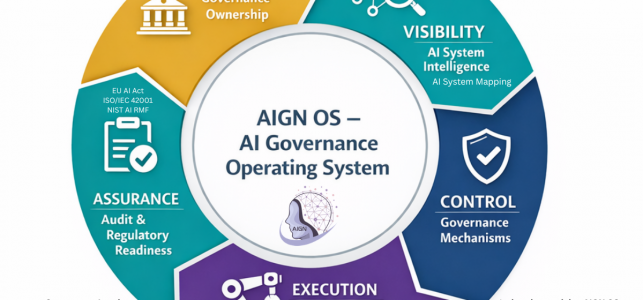
From AI policy to operational AI governance – AIGN OS Implementation Programme
Many organisations have already developed AI principles, policies and governance frameworks.
However, when artificial intelligence becomes operational inside organisations, governance suddenly faces a very different challenge.
Regulators, auditors and executive leadership begin to ask operational questions:
- Where exactly are AI systems deployed?
- Who is accountable for them?
- How are risks monitored?
- Who can intervene when systems fail?
- How can decisions be audited under regulatory scrutiny?
At that moment, AI governance stops being a policy discussion.
It becomes an operational architecture challenge.
The Three Pillars of AIGN OS Implementation
Governance
Architecture Design
Establishing the governance system
The first step is to design the AI governance architecture.
Using the AIGN OS model, organisations establish the structural foundations required for operational governance.
This includes:
• defining governance authority structures
• establishing executive accountability
• mapping governance responsibilities across organisational levels
• aligning governance structures with EU AI Act and ISO/IEC 42001
The objective is to create a clear governance architecture that can operate under regulatory scrutiny.
AI System
Visibility & Risk Mapping
Understanding where AI actually exists
Most organisations lack visibility of AI systems across departments.
AI is often embedded in:
• SaaS platforms
• internal tools
• analytics systems
• automated workflows
• third-party products
This pillar establishes:
• AI system inventories
• governance classification structures
• risk visibility across AI deployments
• mapping of decision-impacting systems
The objective is to provide organisational visibility over AI systems and governance exposure.
Operational Governance Infrastructure
Implementing governance mechanisms
The final pillar focuses on implementing governance mechanisms that allow organisations to operate AI responsibly.
This includes:
• governance control mechanisms
• operational oversight processes
• intervention and escalation structures
• governance documentation and audit readiness
The objective is to establish AI governance systems that remain robust under audit, regulatory pressure and operational complexity.
Programme Structure
The AIGN OS implementation programme is typically delivered as a 90-day governance architecture engagement.
The programme includes:
Phase 1 – Governance Architecture Design
• governance structure analysis
• authority and accountability mapping
• regulatory alignment
Phase 2 – AI System Visibility
• AI system discovery
• governance classification
• risk mapping
Phase 3 – Operational Governance
• governance control mechanisms
• implementation roadmap
• audit readiness preparation
Programme Deliverables
• AI governance architecture blueprint
• AI system inventory and classification structure
• governance authority model
• operational governance control framework
• EU AI Act governance alignment report
Programme Outcomes
After completion, organisations achieve:
• clear executive governance authority
• visibility of AI systems across the organisation
• structured governance mechanisms
• EU AI Act readiness
• auditable governance infrastructure
The result is the transition from:
AI policy → to operational AI governance.
Industries
The AIGN OS implementation programme is applicable across sectors where AI systems influence decisions or operational processes.
Examples include:
Healthcare
Financial Services
Manufacturing
Retail
Public Sector
Critical Infrastructure
About AIGN
AIGN develops governance architectures that allow organisations to operate artificial intelligence responsibly under real-world regulatory conditions.
The AIGN OS – AI Governance Operating System provides the structural foundation for operational AI governance across organisations.
Start the Conversation
Organisations currently implementing AI governance often face similar structural challenges.
If your organisation is currently trying to move from AI policy to operational AI governance, I would be interested to hear how organisations are approaching this transition.